Overview
I saw a new friend reading it, and that made me want to read it too.
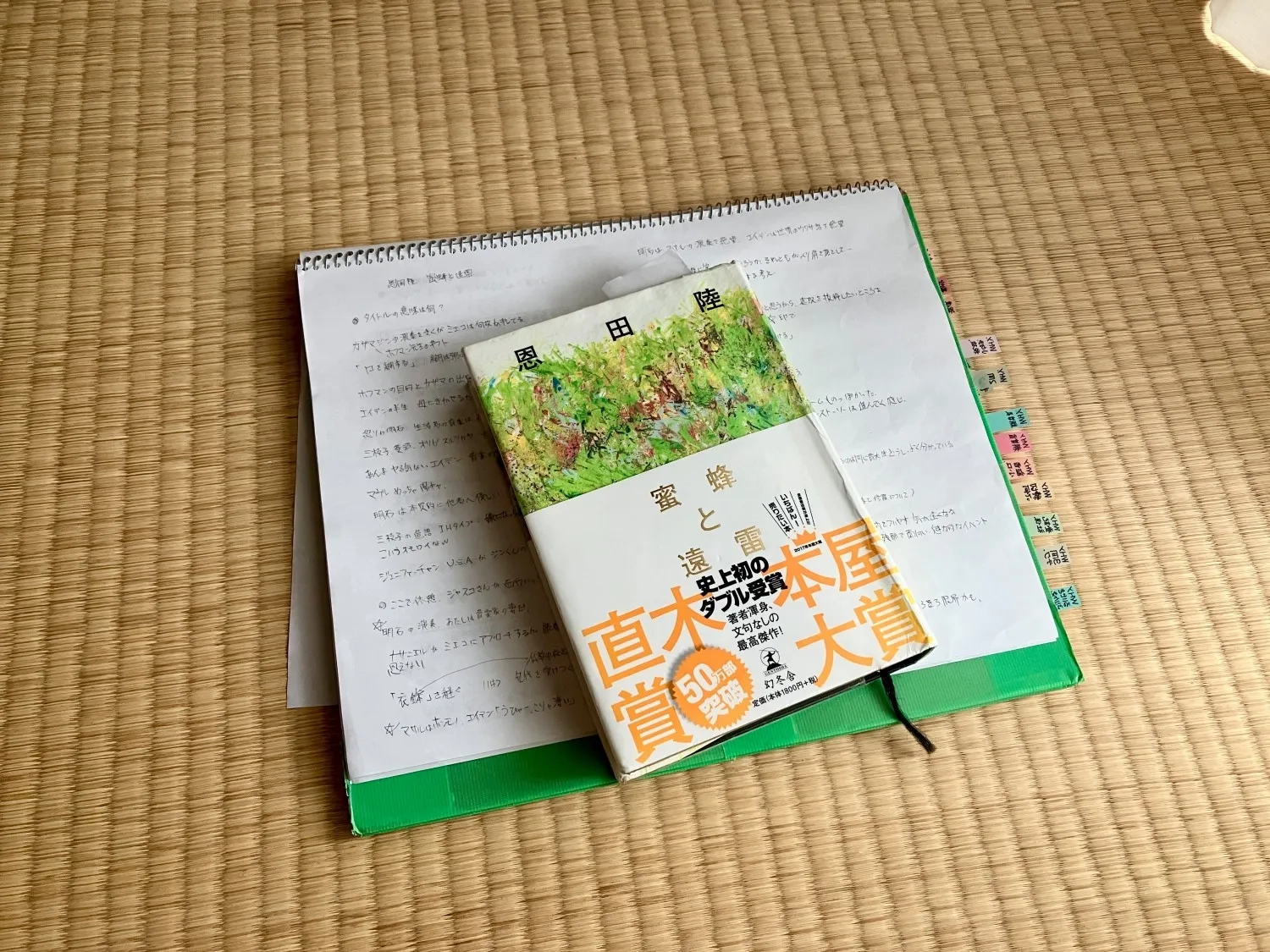
I will write a spoiler-filled summary and my thoughts.
Summary
- The Yoshigae International Piano Competition is held. Brilliant amateurs gather there.
- Jin Kazama: A 16-year-old whose behavior and performance are both strange and overwhelming, as if he is "loved by the god of music." His ears are unbelievably good, and he can hear everything, whether he is inside a soundproof room or inside an orchestra. His belief is that humans originally found music in nature, but now they have shut music indoors, so he is going to set music free!
- Aya Eiden: A 20-year-old genius who has no motivation, which makes the people around her worry. Her mother suddenly died when she was 13, and after losing the person she wanted to play the piano for, her motivation disappeared. But during the competition, she is inspired by other people and becomes motivated again. When she performs, everyone praises her highly, saying things like "she is on a different level," "she has gone beyond talent and reached maturity," and "she is a loyal servant of music, the king."
- Masaru Carlos Levi Anatole: A truly fine young man, 19 years old, who is motivated, emotionally stable, and charms everyone he meets. Even if he had not done music, he probably would have become a real somebody. He is a genius who works steadily and does not mind taking the long way around, and he wins the competition.
- Akashi Takashima: A 28-year-old graduate of a music college, a working adult, and a "person with a life to live," who is overwhelmed by the monsters above. His belief is that the music of someone who lives an ordinary life is not necessarily inferior to the music of geniuses. While having a family and a job, he slightly destroys his life to prepare for the competition and challenges the monsters. He is a man who is fundamentally kind to others, and that personality seeps into his music, so he wins something like a special prize.
Thoughts
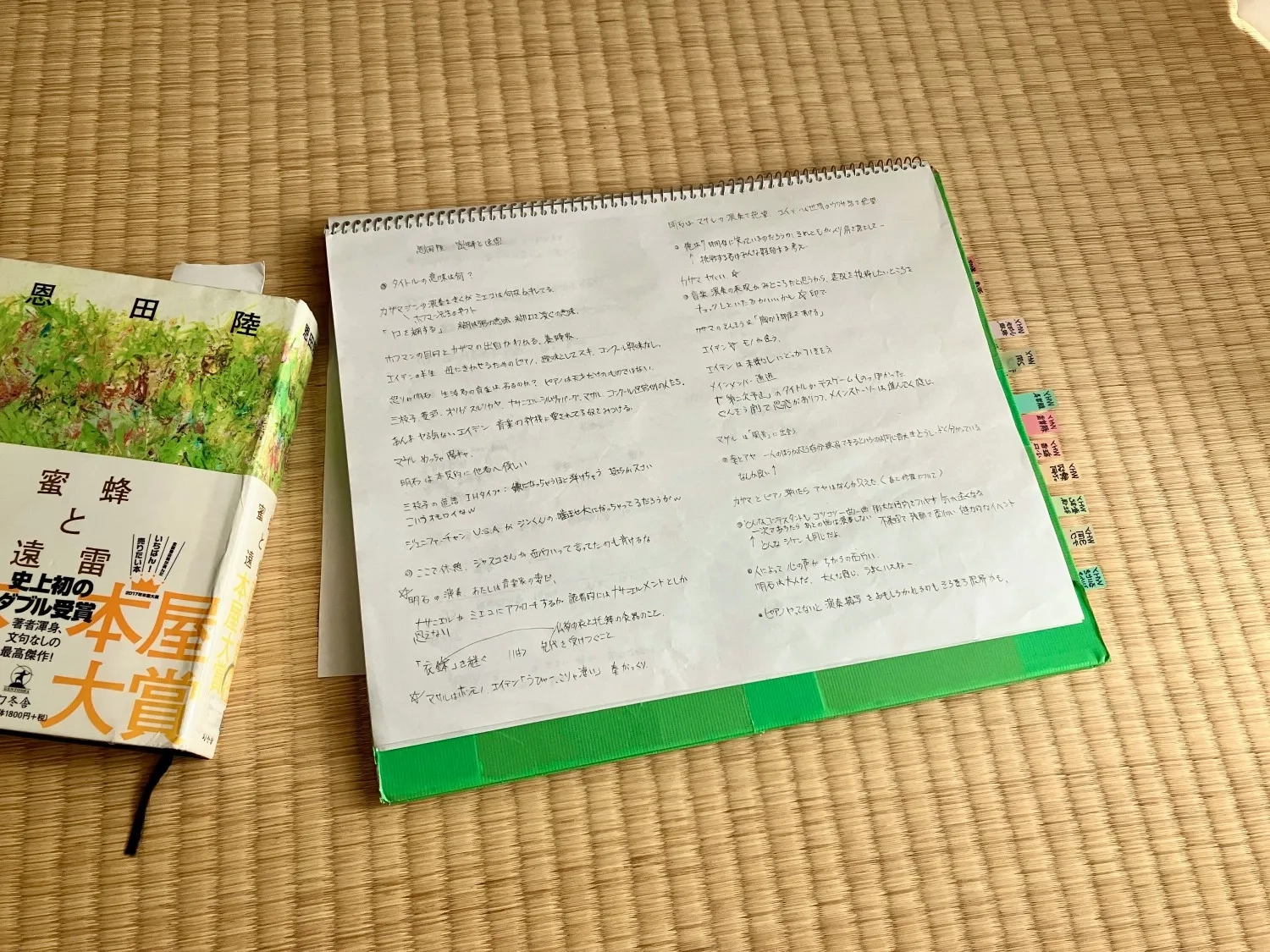
The meaning of Honeybees and Distant Thunder seems to be the sound of honeybee wings that Jin Kazama hears as a symbol of nature, and the sound of distant thunder that he connects with his teacher’s lessons. But does that really symbolize this work? I didn’t really get it.
In the first half, the story shows how the characters came to take part in the competition. No, not only the contestants. The judges also have their own drama. I enjoyed the many different "paths" each person had taken. In the second half, though, it just continues as an inflation-battle story where the contestants are inspired by each other’s music and keep raising their musical combat power. There were scenes here and there that made me chuckle, but there was not much drama. Overall, it was mostly just an inflation battle between musicians, so maybe I could not really enjoy it.
That "inflation battle" is shown by describing each contestant’s performance through metaphors. Because of that, an incredible number of metaphors appear throughout the book. If you ever want to describe a performance with a metaphor, go check Honeybees and Distant Thunder. You will probably find the perfect one.
Here are the scenes I liked here and there↓
- I liked the judge Mieko-san’s made-up word. "IH type" means someone whose technique is amazing: iya ni nacchau hodo hikechau type (the type who can play so well it makes you sick).
- I really related to Akashi-san’s line before the results of the competition were announced: "Will I be smiling seven hours from now, or will I be dropping my shoulders in disappointment?" I thought the same thing while waiting for the result of Eiken Grade 1. Everyone who challenges something experiences this.
- I liked the part where Masaru-kun compares the work of finishing a piece to cleaning a house. "If it is a small house, keeping it clean is easy, but cleaning a large mansion is hard." I get it! Programming is the same. It is easy to keep a small program perfect. But as a program becomes larger, keeping the quality of the whole thing gets harder and harder. Everyone who creates something experiences this.
- The conversation between two judges. "I have a boyfriend now." "But you are not married to him, right? He is not your husband." "True." "That might not be bad either. After all, somewhere deep in my soul, there is still a part of me that resonates with this man." ... This part felt emotional in a good way. I felt the breadth of the novelist’s drawers.
Words I didn’t know↓
- This was my first time learning the phrase kuchi o norisuru (口を糊する). It means to somehow make a living. Nori means rice porridge. It is the same nori as in kokū o shinogu (糊口をしのぐ).
- This was my first time learning the phrase ihatsu o tsugu (衣鉢を継ぐ). It means to inherit something from the previous generation. Ihatsu refers to a teacher’s robe and the bowl used for Buddhist begging.