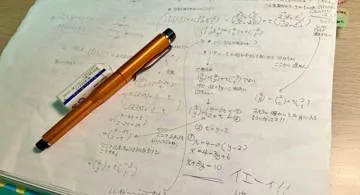
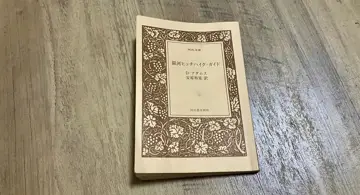
Overview
I had been curious about the Mathematical Girls series for a long time. There are quite a lot of volumes, but a friend had the one about matrices, so I borrowed it and read it.
My friend said, "English, and now math?!" and was impressed, which made me happy, but I’ve always liked things like being well-rounded or interdisciplinary. I feel there’s value in being able to use every part of the body and every part of the brain in the same way.
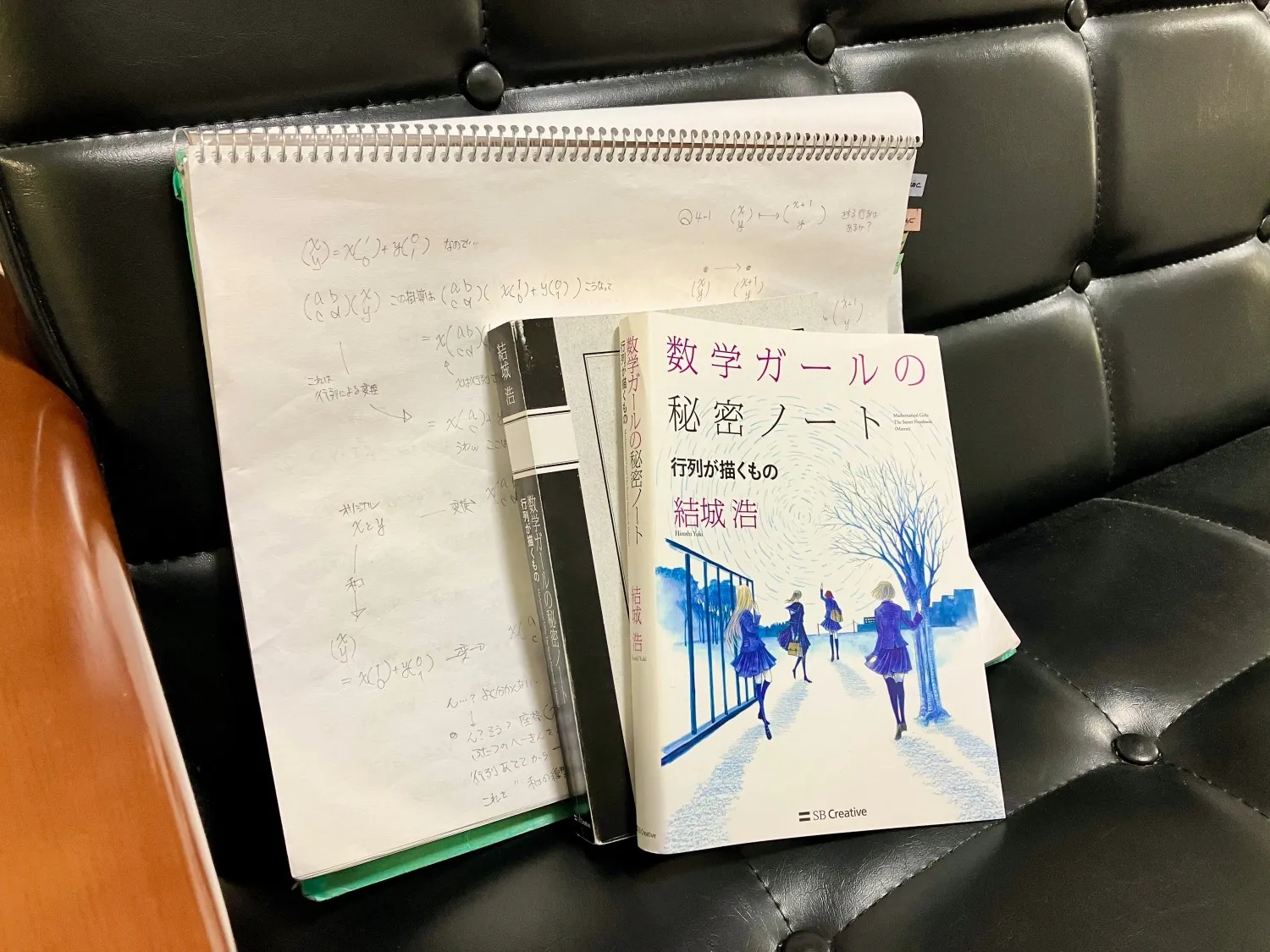
I’ll write a summary and my thoughts.
Summary
Things you should know first when talking about matrices
Something like this ↓ is a matrix.
In Python, it looks like this ↓. Right! It’s not just a multidimensional array, it’s numpy. I see, numpy was a "matrix library."
numpy.array([[a, b], [c, d]])
Matrix addition looks like this ↓. Yeah, makes sense. The matrices must have the same number of rows and columns. As you can see, the commutative law holds.
$$
\begin{pmatrix}
a & b \
c & d
\end{pmatrix}
+
\begin{pmatrix}
a' & b' \
c' & d'
\end{pmatrix}
=============
\begin{pmatrix}
a + a' & b + b' \
c + c' & d + d'
\end{pmatrix}
$$
In Python… if we call the matrices A and B, it looks like this ↓. At first I thought it was list(A) + list(B), but that was wrong.
numpy.array(A) + numpy.array(B)
Matrix multiplication looks like this ↓. This is insane (despair). But this rule is the hardest part, so once you get used to it, the rest should be fine. As you can see (though not at a glance), even though it’s multiplication, the commutative law does not hold. Knowing this lets you make a cheeky comment like, "hehe, are you talking about matrices?" when people argue about multiplication order. Also, as you can see (again, not at a glance), you can only compute it when the number of columns of the first matrix equals the number of rows of the second.
$$
\begin{pmatrix}
a & b \
c & d
\end{pmatrix}
\begin{pmatrix}
a' & b' \
c' & d'
\end{pmatrix}
=============
\begin{pmatrix}
aa' + bc' & ab' + bd' \
ca' + dc' & cb' + dd'
\end{pmatrix}
$$
In Python:
numpy.array(A) @ numpy.array(B)
The zero matrix looks like this. Its definition is: "when you add it to a matrix, nothing changes." The symbol used is O.
The identity matrix looks like this. Its definition is: "when you multiply a matrix from the front or back, nothing changes." The symbol used is I.
The inverse matrix looks like this. Its definition is: "when you multiply it from the front or back, it becomes the identity matrix." The symbol used is \(A^{-1}\). The inside of \(A^{-1}\) is wild, and at first I thought, "there’s no way I’ll memorize this," but after doing exercises, I ended up remembering it naturally because it comes up a lot.
$$
A^{-1} =
\frac{1}{ad - bc}
\begin{pmatrix}
d & -b \
- c & a
\end{pmatrix}
\quad (ad - bc \ne 0)
$$
The determinant looks like this ↓.
What you can do once you know this
-
You kind of get that matrices look cool, but what are they?
-
One of the tools that appear in linear algebra
- Their main role is to function as mappings
- A mapping means transforming coordinates or vectors
-
What does it mean to transform coordinates?
-
It means that, under the same rule, points on a coordinate plane move
- Like a starry sky rotating
-
Amazingly, when you transform a shape with a matrix, the ratio of areas before and after matches the value of the determinant
-
Why? Who discovered that? lol
- Thinking about it, if you transform a shape with a matrix whose determinant is 0 (like the zero matrix), the shape collapses, so the area becomes 0 times… makes sense
Thoughts
I enjoyed it!
- I thought it would be something like
math : light novel = 3 : 7, but it was more like7 : 3. - Just like a math textbook, if you don’t read it carefully and solve the exercises as you go, you’ll stop understanding it completely, so I did a lot of calculations.
- And that was fun… It felt like the brain area I use for studying English and the one I use for programming were working at the same time.
I really enjoyed the exercises!
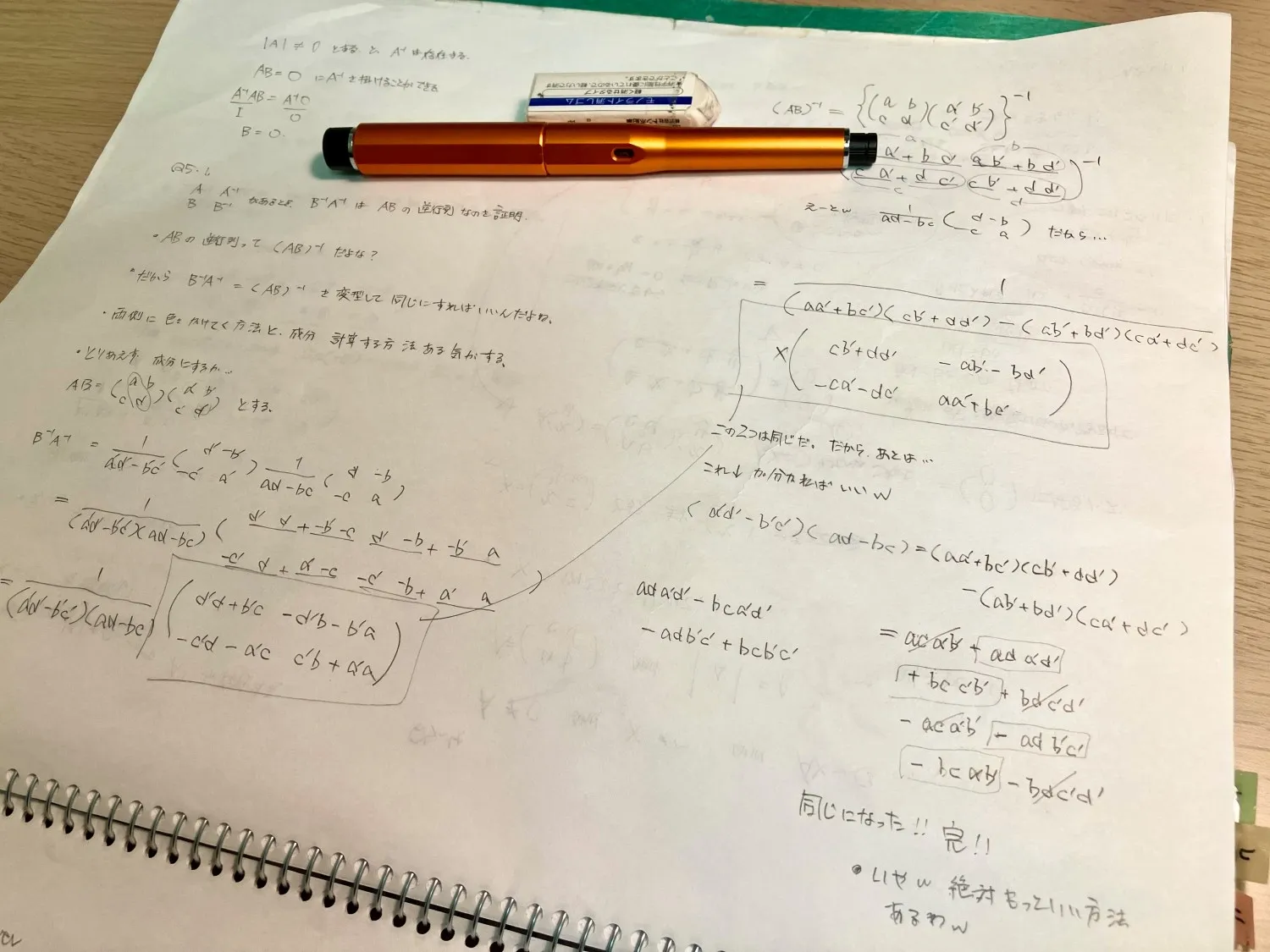
- (Especially because of matrix multiplication) I did a lot of calculations, and I naturally found myself thinking, "If I calculate this honestly every time, I probably won’t finish in an exam" and "There must be a way to shortcut this." I realized my thinking had been tuned into an exam style because of Eiken…
- That method is probably about accumulating patterns like, "when this kind of problem appears, solve it with this strategy."
- Even with just the few problems I solved in this book, I could feel the fun of building those patterns.
- This feeling… it’s similar to when I kept accumulating vocabulary and structures for Eiken… But with Eiken, sometimes I got annoyed and thought, "This isn’t English ability, it’s just like solving riddles! Stop writing unnecessarily complicated sentences!" But with math, there’s none of that! "This isn’t math… wait, no, it’s nothing but math!" It just makes perfect sense.
- Math is fun!!
When mappings came up, I happened to see a short video about mappings
-
Around the time mappings (transforming coordinates) appeared in the book, a short video popped up where Tsurusaki from QuizKnock was talking about mappings…
-
"People understand if you say function, but not mapping"
- "Among mappings, real → real and complex → complex are generally called functions"
- "In English, it’s map"
- And when I heard that, I jumped and thought, "Ohhhh!! I see!! Mapping is like Python’s
map!! It applies a function to each element of a sequence, somap= mapping!!" - It felt like "points connected," or rather "points (math), (function), and (map) connected," and it was super interesting.
- I had a feeling from the start—since I’m a hobby Pythonista—that if I studied math, I’d think, "Oh, I’ve seen this in Python." And that’s exactly what happened.