Overview
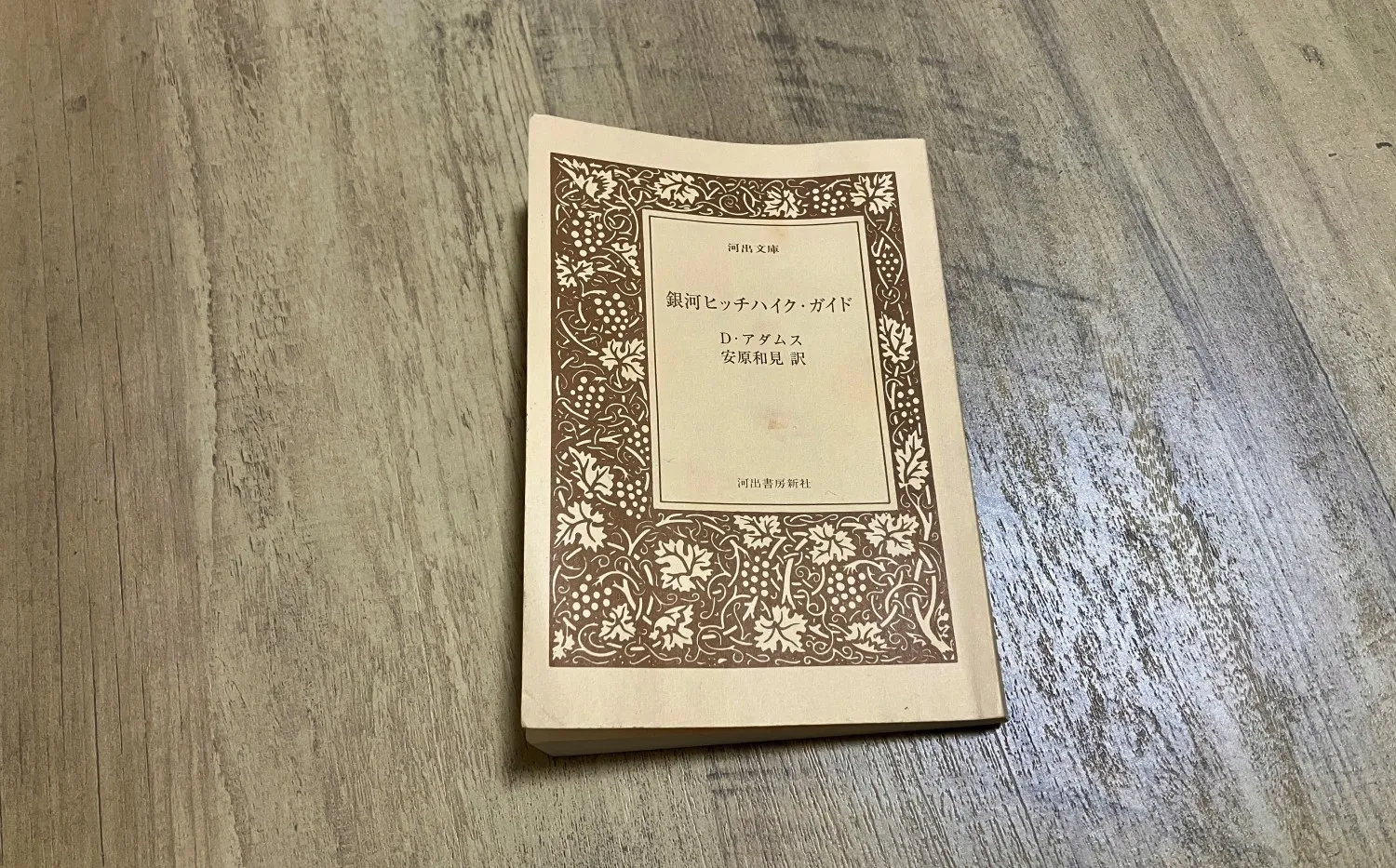
I read it because I borrowed it from someone. It is a pretty famous work, right? I will write a summary and my thoughts.
Summary
- Long ago, superintelligent pan-dimensional beings built a computer called Deep Thought.
- Deep Thought calculates that “the answer to life, the universe, and everything” is “42.” For the superintelligent pan-dimensional beings, this answer makes no sense.
- The reason the answer makes no sense is that the superintelligent pan-dimensional beings do not understand the question itself. So next, they need to calculate what “life, the universe, and everything” actually is.
- The computer used for that calculation, a computer greater than Deep Thought, is Earth.
- Earth has been calculating that question for a very long time, and in our dimension, the superintelligent pan-dimensional beings operate Earth in the form of mice.
- There are five minutes left until the result comes out.
- At that exact moment, Prostetnic Vogon Jeltz’s spaceship demolishes Earth to make way for a hyperspace bypass.
- The mice are furious, but there is nothing they can do, so they decide to build Earth again. The planet that will actually build it is Magrathea, whose main industry is planet construction.
- But then the mice hear something. Apparently, there is one Earthman who escaped from the former Earth. His name is Arthur Dent.
- Ford Prefect comes from a planet near Betelgeuse. He came to Earth to update the Earth entry in The Hitchhiker’s Guide to the Galaxy. There, he becomes friends with Arthur Dent. He also hears about Earth’s destruction, and he takes Arthur with him, so they escape from the former Earth together.
- The mice think about cutting Arthur’s brain into small cubes and reading the calculation result of the former Earth from it. True, there were still five minutes left before the calculation was complete, so the calculation was not finished yet. But Arthur’s brain was part of the former Earth, so there may be clues to the answer left inside it. Rather than rebuild Earth and wait for the calculation again, they should try this.
- But Arthur’s group stops them. The group is Ford Prefect, his relative and the President of the Galaxy Zaphod Beeblebrox, their companion Trillian, and the android Marvin.
Thoughts
Overall, I enjoyed it as an SF mystery, like when I was reading James P. Hogan’s Inherit the Stars! And it also has comedy elements, plus strong narrative prose craft (the narration itself is goofy and funny).
The early conversations between Arthur Dent and Ford Prefect are really funny.
- Arthur: “Did I do something wrong? Or was the world always like this, and I just never noticed because I was spacing out?” (This is what Arthur says because Ford’s explanation about space makes absolutely no sense to him. As a thought you might have when you run into a totally confusing situation, I think it is very clear.)
- Ford: “Oh, what did it say?” Arthur: “I told you, I wasn’t listening!” (You cannot understand the joke’s context from this alone, but I like how Arthur talks back to Ford without hesitation, even though Ford is an alien.)
A phrase I liked:
- “They were suddenly seized by a fit of disappearing curiosity and hurried back to the Heart of Gold.” (What is this wording? But I totally get it! Sometimes you really do get seized by a sudden fit of disappearing curiosity. What an amazing ability to put things into words.)
Things that excited me:
- The development that Earth itself is a computer... I mean, in a way, it is kind of classic, but I like it.
- The development that the intelligence of Earth’s creatures goes humans < dolphins < mice... I mean, in a way, it is kind of classic, but I like it.
- The development that the supposedly destroyed planet Magrathea was actually in the middle of sleeping through an age of recession... Wow, I love this kind of huge-scale development. This is exactly what space SF should be like.
About “understand the question before you seek the answer”:
- That makes sense. The idea that the question is more important than the answer is pretty famous, isn’t it?
- As far as I know, Wittgenstein wrote something like “if a question can be asked, then an answer can also be given” in Tractatus Logico-Philosophicus.
- By building this kind of widely known idea into the story, the scenario becomes mysterious, while also making it easier for readers to follow. That is what I thought!
Things I did not really understand:
- Zaphod Beeblebrox, the President of the Galaxy, learned from the previous president, Yooden Vranx, how to steal the Heart of Gold, which can use the Improbability Drive, and he used the Heart of Gold to come to Magrathea. Hmm, I understand that he had erased part of his own memory at that time. If he had the motive of stealing the Heart of Gold in his memory, he would not have been chosen as president. But why did he come all the way to Magrathea? Was that ever revealed? Maybe that is in the sequel... But for works that resolve foreshadowing in a sequel, I am not sure whether the payoff will be good... Because “a highly rated work that resolves its foreshadowing inside the work itself” proves that it has a great foreshadowing payoff, but “a highly rated work that resolves its foreshadowing outside the work itself” could very possibly have a terrible payoff in the sequel.
-
For me, the only person who does brilliant foreshadowing payoffs even across separate volumes is Ishio Yamagata. (I love Rokka: Braves of the Six Flowers way too much.)