Overview
The previous book I read was really interesting.
In my book review, I wrote the essence of the summary and my thoughts, but for this book, solving the exercises was also fun, so I decided to write about the parts that left a strong impression.
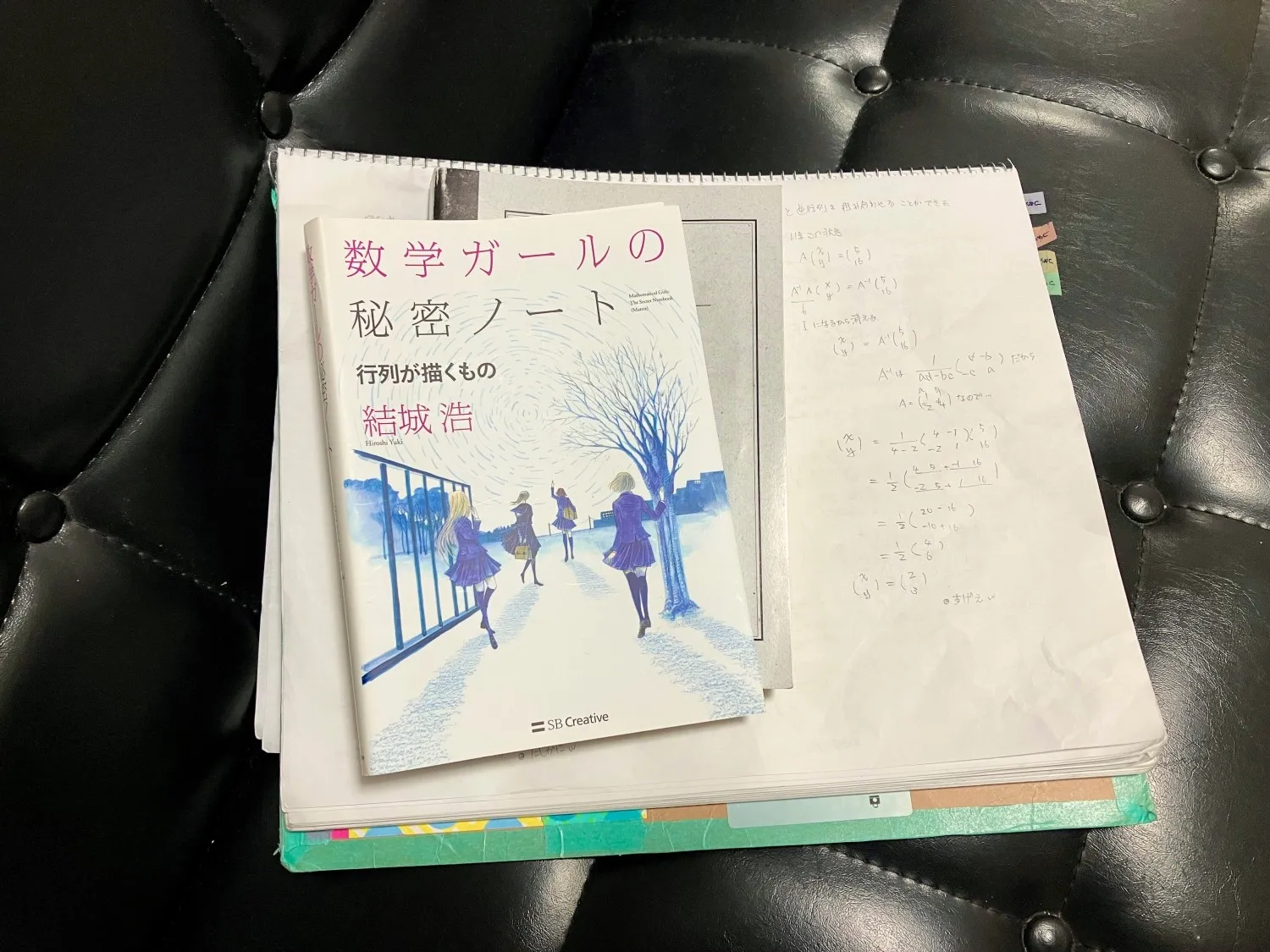
Exercises I Enjoyed
Find the inverse of the inverse matrix!
By definition, this returns to the original matrix, but I wasn’t satisfied, so I did the component-wise calculation.
If you multiply this carefully, it becomes:
Then finally, it turns into this ↓. By doing a lot of these multiplications, you end up memorizing that crazy multiplication rule without even noticing.
Let’s calculate patiently
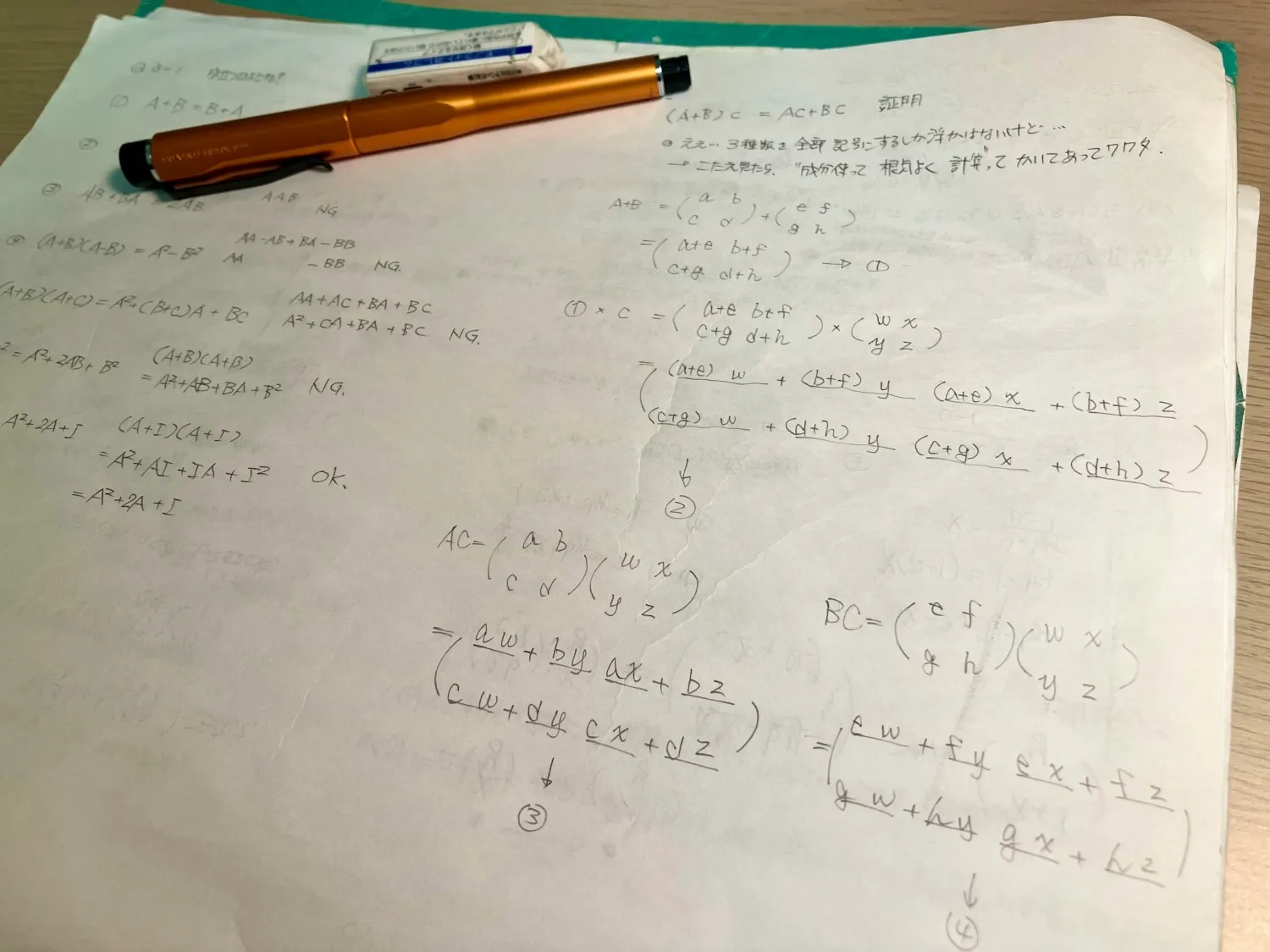
Proof of this equality ↓
The distributive law of matrices. I thought, "Hmm… I can only think of writing everything in components and calculating…"
Then the solution literally said, "Let’s calculate patiently using components," which made me laugh. It becomes like this ↓
I actually did it properly.
Some equations cannot be solved
This one was difficult but interesting. The question is: does such an \(X\) exist?
First, rewrite it like this:
Then form a system of equations:
From (2), \(c\) and \(d\) are fixed as 0 and 1. On the other hand, \(a\) and \(b\) cannot be determined no matter what, so the answer is: impossible.
At first, when I saw this, I struggled to understand at what point I could confidently say "impossible." The idea that an identity that can never hold appears during the process is confusing if you’re not used to it.
Maybe it helps to think like this: when you see an equation, be aware of whether it is an equation or an identity.
- Are we supposed to solve all variables in this expression?
- If you want to solve everything and eliminate all variables, it’s an equation
- If you must not solve them (like \(x, y\) here, which remain until the end), then it’s an identity. Especially when it has the form
(...) x + (...) y = nonzero number, it should trigger a mental alert
I don’t even know what I’m supposed to answer
If you transform this ↓
by this ↓
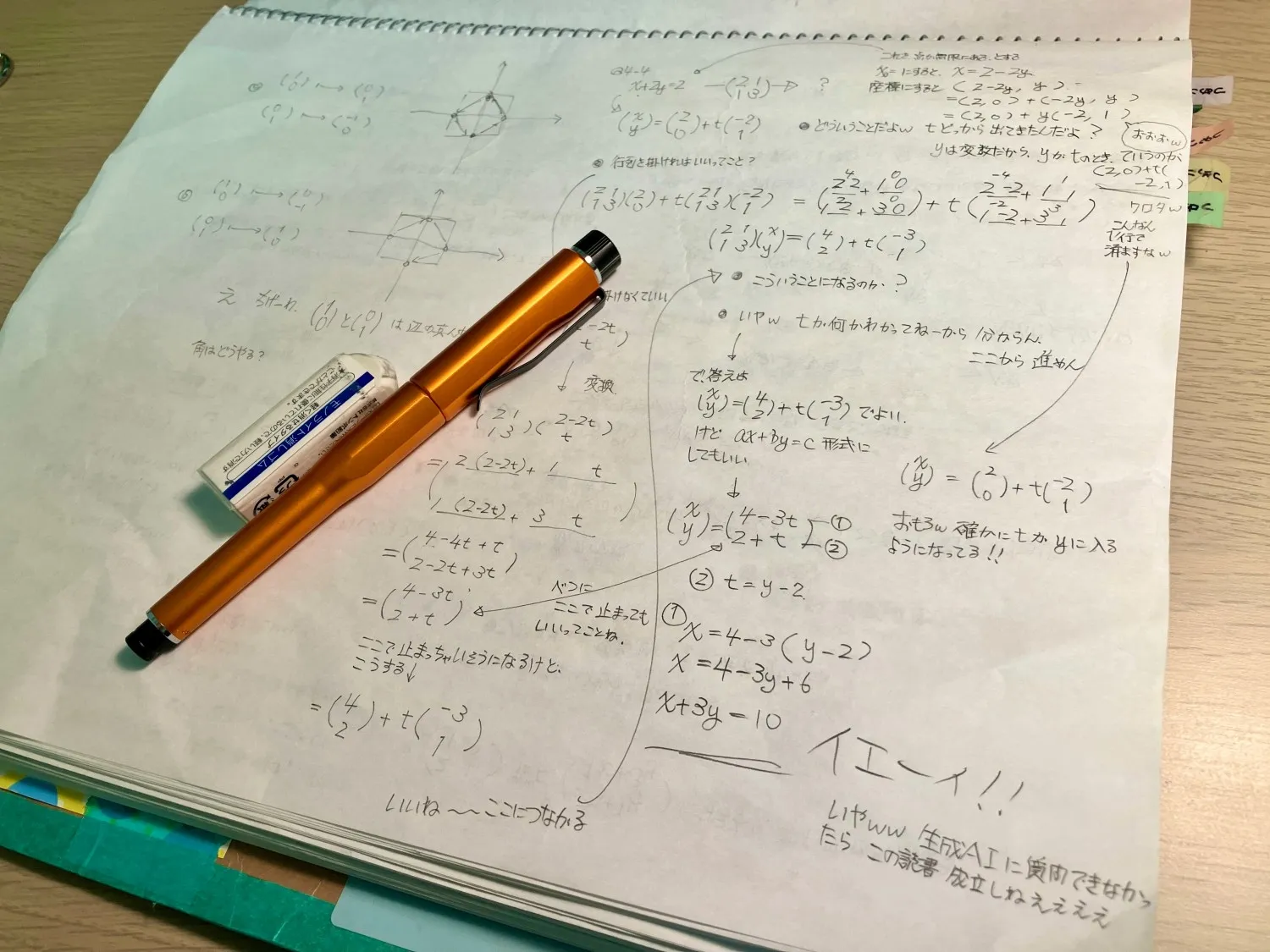
what kind of figure do you get?
…What do you mean, “what kind of figure”? lol
I don’t even know what I’m supposed to answer: when you write an equation, it represents a figure on the coordinate plane. So you just need to answer what form \(ax + by = c\) the original \(x + 2y = 2\) turns into.