Overview
Apparently, a high school student I know asked for the winner of the current Akutagawa Prize (the 175th) as a reward for passing the Eiken exam. Wow, how admirable. What kind of book is it? Let’s see, the synopsis says...
“I am the only cleaner in this hotel. I collect the remains of murdered zombies and keep the world beautiful.”
This sounds incredibly interesting. I’m buying it too.
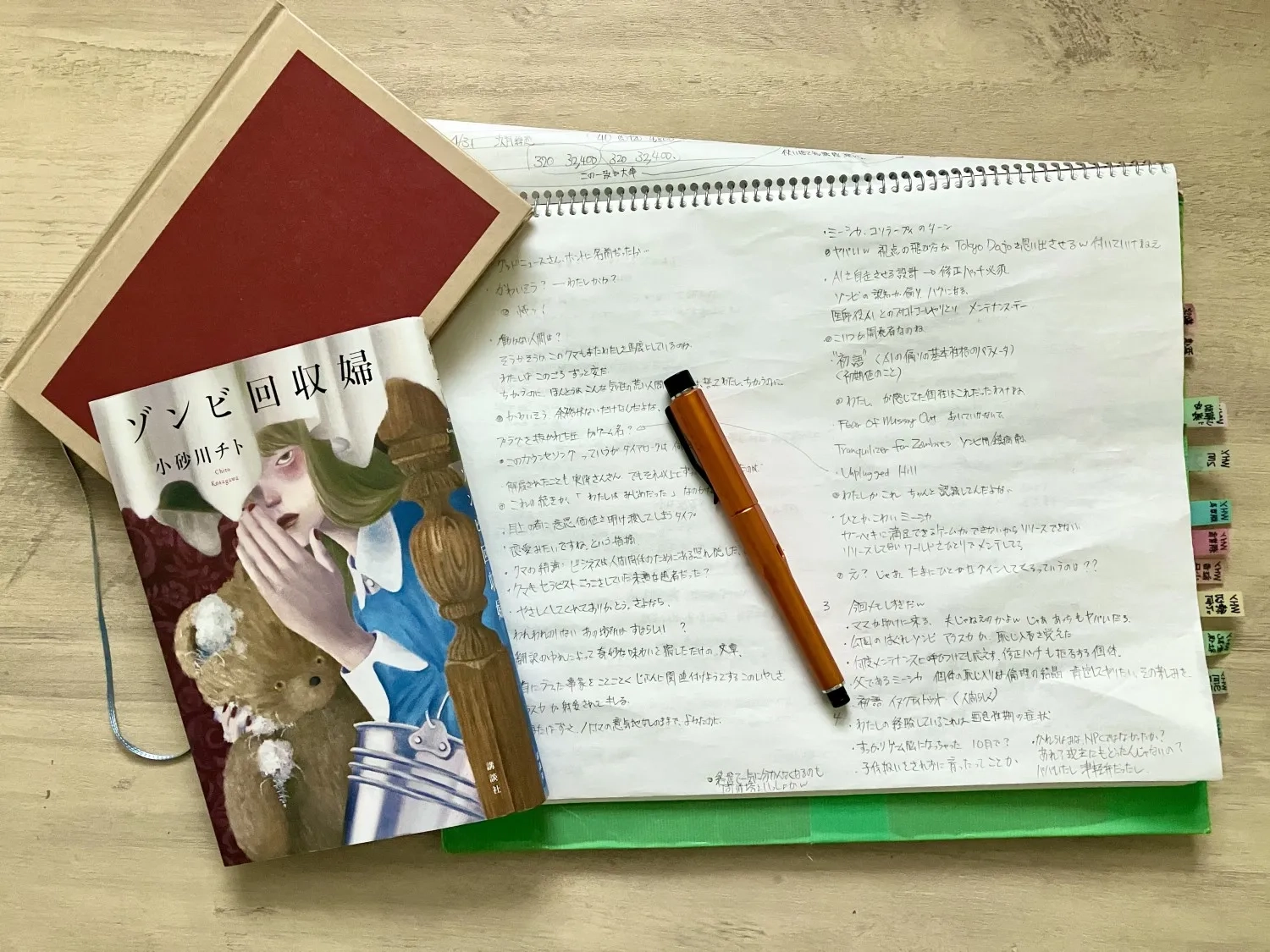
So, here is my spoiler-filled summary and review.
Summary
- Mishka Kosolapyi, a lonely game developer, releases a demo of Unplugged Hill, which features AI-powered NPCs, after making the popular Fear Of Missing Out and the less successful Tranquilizer for Zombies.
- Unplugged Hill receives mixed reviews. Mishka becomes mentally unwell, and his perfectionism prevents him from ever releasing the full version. He spends his deeply unhealthy days manually maintaining the game world, which continues to operate through AI.
- His maintenance work includes caring for the zombies’ mental health. After all, they are his children. He personally gave each one an initial setting called its “first words.” He has to take good care of them.
- Meanwhile, there is a married couple who both lose their jobs because of the spread of AI. The husband suddenly becomes energetic and goes on a trip alone. The wife becomes mentally unwell by herself, gets absorbed in the demo of Unplugged Hill that happens to be in their home, and shuts herself away inside a VR headset.
- At the Oral Stage Hotel, the main setting of Unplugged Hill, she loses her temper and shoots an NPC to death. That NPC was responsible for cleaning up zombie remains inside the game. He does not respawn, so the defeated zombies continue to pile up. She takes the collector’s place and becomes a zombie collector herself.
- Starved for work, she spends her days working as a collector. For about ten days. In the VR world. She begins to notice the zombies’ individual personalities and grows fond of them. She names her favorite one Alaska and becomes especially attached to it. Of course, its personality comes from the “first words” Mishka gave it.
- During those ten days, Mishka repeatedly performs maintenance on all the AIs. This takes the form of counseling sessions in which he speaks with them one by one. When her turn comes, she talks with Mishka... while both of them believe that the other is an AI... and through this conversation, she discovers the source of her own mental problems.
- She grew up through “the kind of parenting in which a family that hates dogs suddenly begins raising a large dog.” Her parents always treated her not as a child, but as a fully grown person. She became someone who was desperate for self-worth. Whenever she met someone above her, she would surrender her own will and value to that person. She also became someone deeply shaped by the belief that “those who do not work should not eat.”
- Unplugged Hill is an ordinary online game available to the public, so players occasionally enter it. When one player kills her favorite zombie, she becomes furious and beats the player down. From that point on, she continues searching for the zombie after it respawns.
- The “first words” Mishka gave that zombie were “Be human.” Because of this initial setting, the zombie could not properly carry out its duty as an NPC zombie. After respawning, it did not return to the Oral Stage Hotel and instead became a stray zombie. When Mishka sees this, he realizes that the “real event” he has always dreamed of has finally happened, and he bursts into tears.
- Meanwhile, her parents discover her wearing the VR headset, thin and weak after going ten days without food. She is then admitted to a treatment center. Apparently, several patients there can no longer distinguish reality from virtual reality because of VR.
- Her condition improves for a while, but in the end, it does not work. She eventually becomes able to visit the Oral Stage Hotel behind her closed eyelids, even without a VR headset. There, she once again works as a zombie collector, and she is happy.
- During this experience, she realizes once again that her personality was built from the lessons her parents taught her: “Those who do not work should not eat,” “Behave properly, how embarrassing, do not cause trouble for other people,” and “Hurry, hurry, get results, hurry, hurry, do not make mistakes, improve, become better, develop, make progress, do not make a mistake even if it kills you, evolve.”
Thoughts
About Mishka
- Mishka, how did someone with your personality manage to release two games?
- Mishka, the mentally unwell perfectionist, says to himself, “Shut up with all that noise! I still want to put the light into it carefully! I do!” Ah... This is how creators should be...
What Does “Oral Stage Hotel” Mean?
- I mean, the name makes so little sense for a hotel that, at first, it made me wonder, “Is the translation of this game so bad that it only looks mysterious for no good reason?” I even thought, “Maybe the protagonist’s English is so poor that she has mistaken a normal part of a conversation, ‘good news,’ for someone’s name?” I was wrong.
- Apparently, the oral stage generally lasts from birth until around the age of two. The developer thinks of the zombies living in the hotel as his children, so perhaps he gave the hotel that name because it is where the zombies spend their early childhood.
About the Husband
- Has the husband gone mad?
- I am not particularly surprised that she is shocked by the change in her husband. After all, I think the two of them had already failed to build a proper relationship. They probably did not share much information about their daily lives. It would not be strange if the husband had made many friends without her knowing. Maybe he had also been playing musical instruments with them.
- After all, she says, “In other words, I hardly knew that man at all.” It is sad to fail at building a relationship even though you live together.
Things I Simply Found Interesting
- It was difficult to understand while I was reading, but I later realized that the story properly follows a “mystery → explanation” structure. I liked how it felt like a mystery novel.
- “I” knows that the VR world is Unplugged Hill. So why does she become unable to distinguish reality from virtual reality? One reason is probably that she has such a poor understanding of IT systems. Because of this, when she sees something like “letters carved into a zombie,” the idea of a technical cause does not occur to her, and she instead treats it as something mysterious. In any situation, when your understanding is limited, you become able to communicate only with people whose understanding of reality is limited to the same degree. Continuous learning is important.
About “Me-ness”
- Most of me had been taken over by this society. Which parts of my life contained my “me-ness”?
- “Me-ness” is such a good word, isn’t it?! It means asking what I truly want to do and which parts of me are genuinely mine, right? It is a great word that expresses all of that in a single term.
- So, which part of her contained that “me-ness”? Well, it was probably the belief her parents planted in her: “Those who do not work should not eat.” She even says, “Those words were me. They were me itself.”
- The Zombie Collector is the story of her realizing this.
- The sensational image of her becoming a VR-obsessed gamer who goes on a violent rampage is strongly emphasized, but that is only a setting designed to make her self-discovery more vivid.
So, in my view, The Zombie Collector is a story in which “I” finds her identity in working perfectly. Of course, I do not think this makes her happy. She has only managed to recognize the “curse” placed on her by society and her parents. Well, since this is a literary work, I suppose it is asking us, “Aren’t there a lot of people like this?” Alongside this is Mishka’s belief that imperfection itself is what makes us human.
Words I Did Not Know
- Uchi (心の裡): Apparently, it means something like the inside or hidden side of one’s heart. It appears at Level Pre-1 of the Kanji Kentei.
- Banquet hall: A large room used for parties and other events.
- Oral stage: A term created by Freud. It is the first stage in the theory of psychosexual development and generally lasts from birth until around the age of two.
- Hitoikire (人いきれ / 人熱れ): A state in which heat and humidity build up because many people are gathered in one place.
- Kyūtetsu kōdō (吸啜行動): The action of holding something in the mouth and sucking it.
- Cookie dough: Cookie mixture before it is baked.
- Miniature Pinscher: A cute dog breed that looks like a tiny Doberman.
- Subacute stage: The period between the acute stage, which lasts for several days after symptoms begin, and the chronic stage, in which symptoms are stable but difficult to cure completely.