Overview
I borrowed this book from someone I know and read it. Here is my summary and what I thought of it.
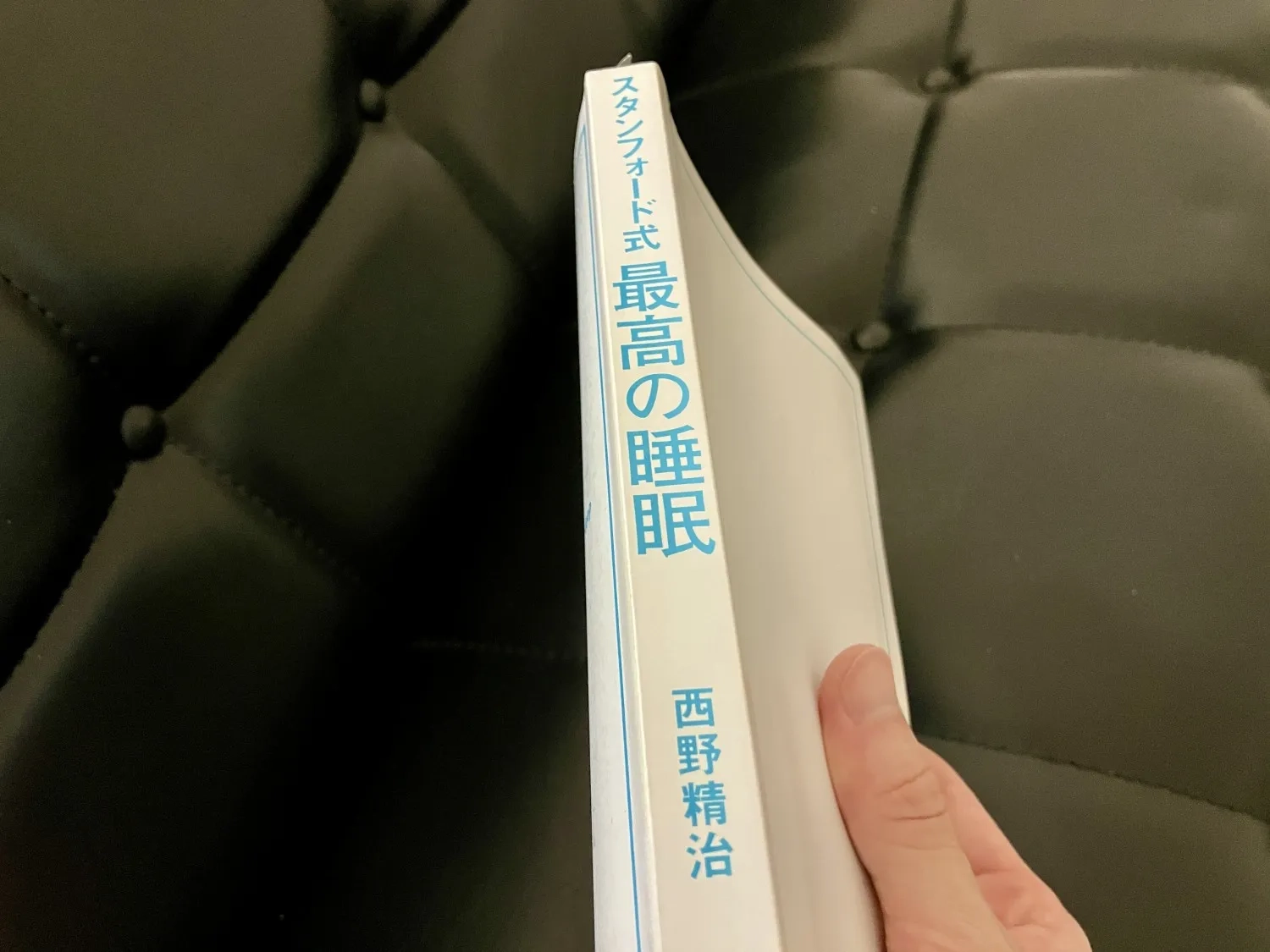
Summary
What I really want to know is how to sleep better, so let's start with the methods that seem useful for that.
- First, the basic rule is to go to bed at your usual time.
- Take a bath to raise your skin temperature and core body temperature.
- Your body releases heat, and both your skin temperature and core body temperature fall. Spend the time before bed doing things that help your parasympathetic nervous system take over.
- This brings your body closer to its natural state before sleep, making it easier to fall asleep and helping you get good non-REM sleep during the first 90 minutes.
- Use the two-alarm method to wake up during REM sleep (the first alarm is quiet, and the second goes off 20 minutes later at a normal volume).
Now, let's go through the reasons behind all this.
- Why does body temperature matter?: Normally, your core body temperature is more than 2°C higher than your skin temperature. Apparently, when you sleep, your skin temperature rises and your core body temperature falls, reducing that difference to less than 2°C.
- So the idea is to use heat loss to lower your core body temperature?: Well, your body lowers it on its own. The idea is to take a bath to help that process go more smoothly.
- But doesn't taking a bath make you hotter?: It does, but that also causes your peripheral blood vessels to widen. This makes it easier for your body to release heat, so your temperature can fall more easily after rising. That downward change is similar to what naturally happens before sleep. In other words, a bath supports a natural process.
- If we want to widen our peripheral blood vessels, couldn't we just do some light exercise?: That could work too. But exercise might also activate your sympathetic nervous system, so, well, a bath is the recommended option.
- What's so special about the first 90 minutes of sleep?: In humans, one cycle of non-REM and REM sleep lasts about 90–120 minutes. This cycle repeats around four times. The "first 90 minutes" refers to the first cycle.
- Why focus so much on those first 90 minutes?: The benefits of non-REM sleep during the first cycle are amazing. This is when sleep pressure (the urge to sleep) is reduced the most, the autonomic nervous system becomes most balanced, and the most growth hormone is released.
- Why should we wake up during REM sleep?: REM sleep is a lighter stage of sleep, so waking up during it is more natural. Waking up during non-REM sleep makes you feel groggy.
- What's the two-alarm method?: It's a way to increase your chances of waking up during REM sleep. If a quiet alarm wakes you up, you're probably in REM sleep. Probably. Even if you're in non-REM sleep when the first alarm goes off, there's a good chance you'll have moved into REM sleep 20 minutes later. That's when the second alarm goes off.
- What did you mean by going to bed at your usual time?: Your brain manages your body's condition according to its circadian rhythm. If you don't follow that rhythm, the methods above won't work as well. Basically, get some sunlight during the day and take it easy at night.
Those are the main methods. Here are some additional tips to support them.
- If you soak in a bath for 15 minutes, your body temperature should reach the ideal state for sleep about 90 minutes afterward.
- If you take a shower instead, you can reach that state sooner.
- The important thing is to let your body release heat and lower its temperature. So don't put on too many clothes after a bath, even in winter. That would stop heat from escaping through your peripheral blood vessels. Wearing socks while sleeping also prevents heat from escaping through your feet, so that's not recommended either. Wearing socks to warm your feet and then taking them off to let the heat escape is fine.
- Sleep has an interesting feature: it's easy to shift your schedule later, but difficult to shift it earlier.
- There's something called the "forbidden zone" (the sleep forbidden zone). Apparently, the two hours just before your usual bedtime are when it's hardest to fall asleep.
- The cause isn't known, but once you know about it, you can see why thinking, "I have to get up early tomorrow, so I'll go to bed an hour earlier tonight," means entering the sleep forbidden zone.
- In fact, going to bed at your usual time and losing an hour of sleep might make it easier to fall asleep and give you a better chance of maintaining your sleep quality.
- It's well known that drinking a lot of alcohol lowers sleep quality. However, strong distilled spirits apparently aren't quite as bad as you might expect. The book says that some opera singers take a quick shot of vodka and use the sudden feeling of drunkenness to fall asleep.
- If you have to work through the night, set an alarm for about 110 minutes later and get those "first 90 minutes" of sleep before starting your work for the rest of the night.
- If you work first and try to sleep near dawn, your brain may be too excited from concentrating to fall asleep.
- On top of that, as morning approaches, your circadian rhythm activates your brain and makes your sympathetic nervous system more active.
- In other words, even if you use the same amount of time, sleeping first makes more sense than leaving sleep until later.
- The reason smartphones affect sleep isn't blue light, but the way using them and looking at their content stimulates your brain.
- The familiar advice to "get out of bed instead of staying there when you can't sleep" fits with cognitive behavioral therapy. It's useful to treat your bed as a place for sleeping, not a place for reading books or watching TV.
That's it for the methods. Here are some other things that made me go, "Oh, really?"
- The time it takes to fall asleep is called sleep latency. Apparently, it takes a healthy person around 7–8 minutes.
- According to an NHK survey, 60% of people went to bed by 10 p.m. in the 1960s, but that figure had fallen to the 20% range by around 2000. People these days stay up too late.
- According to research by the University of San Diego, Stanford University, and Nagoya University, women who slept seven hours had the lowest BMI. BMI gradually increased among those who slept either less or more.
- The brain floats in 150 cc of cerebrospinal fluid. Waste products from the brain are released into this fluid, which is replaced four times a day. When waste builds up, amyloid beta, one of the factors linked to Alzheimer's disease, accumulates in the brain. Apparently, this waste removal is most active during those famous "first 90 minutes."
- The author uses eye drops for tired eyes before going to bed.
- During REM sleep, the cerebral cortex is active, so dreams tend to have stories and feel close to real experiences. During non-REM sleep, the cerebral cortex is asleep, so dreams tend to be abstract and make little sense. Also, the dream you remember when you wake up is the one you were having just before waking. So if the dream you remember has the features of a REM-sleep dream, it means you woke up at a good time.
Here are a few points from the section about fighting sleepiness, which I personally felt was unnecessary.
- The drowsiness that makes you nod off in the afternoon is called the afternoon dip.
- In the end, power naps are the best.
- Humans may have taken naps during the course of evolution.
- People who nap for less than 30 minutes have one-seventh the risk of developing dementia compared with people who don't have a napping habit.
- People who nap for an hour or more have twice the risk of developing dementia compared with people who don't have a napping habit.
- So keep your naps to 20 minutes.
My Thoughts
Apparently, this is a famous book, but I didn't come away with a particularly good impression.
- It feels a bit scattered and poorly organized. Some of the explanations are also rather vague, especially at important points.
- Ideas like "core body temperature tends to fall significantly after rising" and "warming your hands and feet helps your body release heat and lower its temperature" are very important. But the explanations aren't detailed enough, making them hard to understand.
- I felt that the final chapter about the afternoon dip was unnecessary. I had the same experience with a book about eating one meal a day. When a book contains plenty of useful information about its main topic but adds unrelated material at the end, I can't help thinking, "What? Did you have a page-count target to meet?" I wish authors would focus on their main topic.
On the other hand, because the book is so scattered, it discusses the same ideas in different places. You could argue that this repetition makes it easier to understand which points are important. Maybe I just don't like the way it's written. After all, what I really wanted was to learn effective methods for sleeping better, and I did achieve that goal. In particular, learning that "I need to get up early, so I'll go to bed early" isn't necessarily a good idea was surprising and useful.
Some of the advice is pretty hard to fit into my current habits, though...
- I can only play Splatoon with my friends at night → That would probably make my sympathetic nervous system extremely active, so it's no good.
- Most of my hobbies involve a PC and using my brain → My sympathetic nervous system would be very active.