Overview
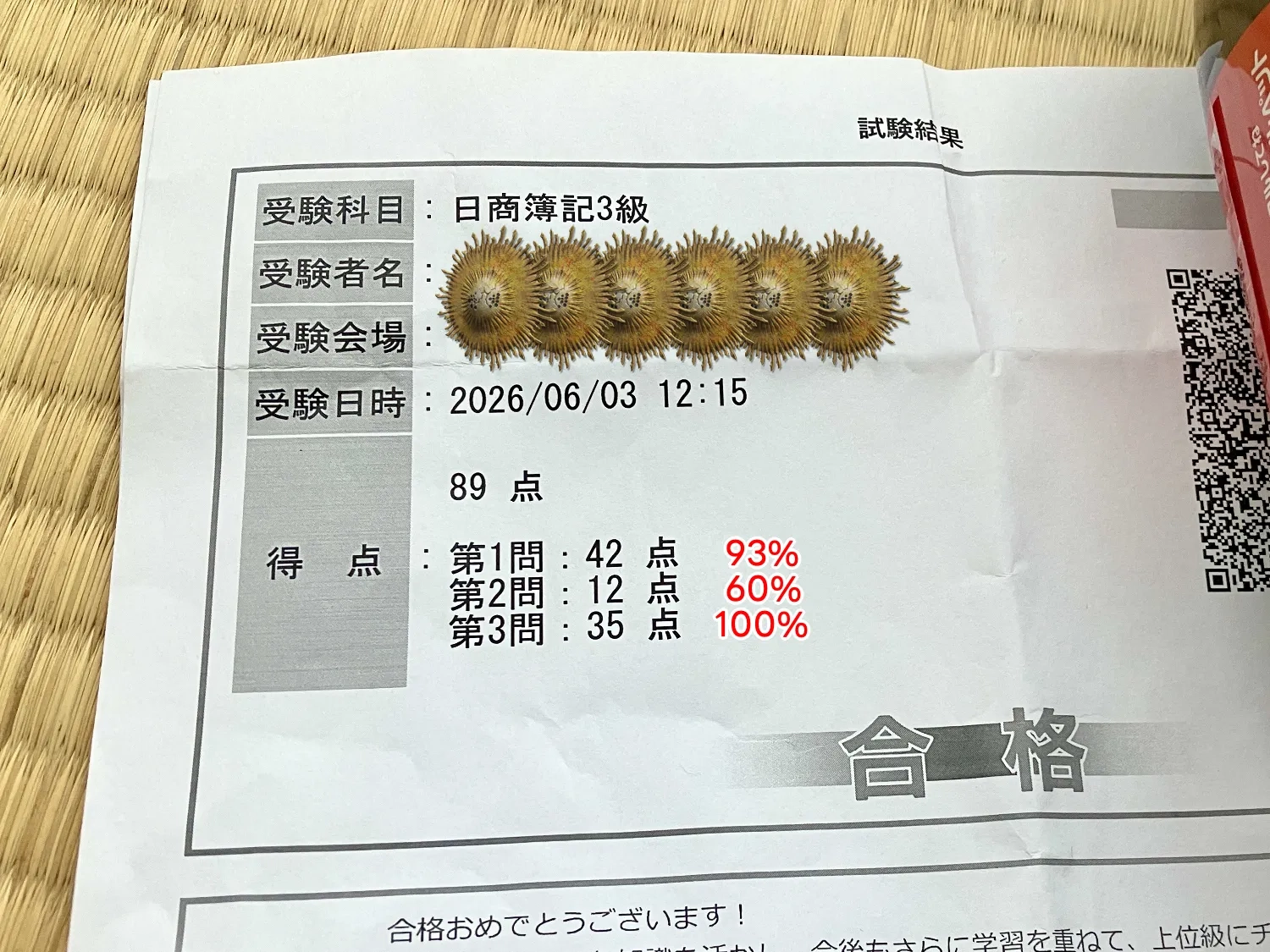
I got Bookkeeping Grade 3, so I’ll write down my thoughts. (For privacy, I am using Goldmask.)
Memories of Studying and the Exam
- I took the CBT (Computer Based Testing) version. It was my first CBT.
- CBT is great!
- You can choose your exam date freely.
- It seems that the questions are randomly built from a stock of problems, and because of that system, the average score seems to stay stable. That is good.
- For me, someone who “knew basically zero” about bookkeeping, this is what I studied↓
- Watched all 23 lessons of CPA Learning’s Nissho Bookkeeping Grade 3 course (https://www.cpa-learning.com/courses/90002)
- Watched all 15 lessons of CPA Learning’s Nissho Bookkeeping Grade 3 Net Exam Preparation course (https://www.cpa-learning.com/courses/420025)
- Did all the practice for Questions 1, 2, and 3 in the workbook distributed by CPA Learning
- From those↑, made my own “My Strongest Workbook” with only the questions I got wrong, and played with it
- Became able to score 90 or higher steadily on CPA Learning’s Nissho Bookkeeping Grade 3 Net Mock Exam (https://www.cpa-learning.com/courses/360011)
- The videos were so long! Just the Grade 3 course (16 hours) and the Net Exam Preparation course (7 hours) already add up to 23 hours.
- They were too long, so I watched them at 1.5x speed.
- Even so, when I stopped the video for each practice problem and actually worked it out by hand, it took about twice the video time every time.
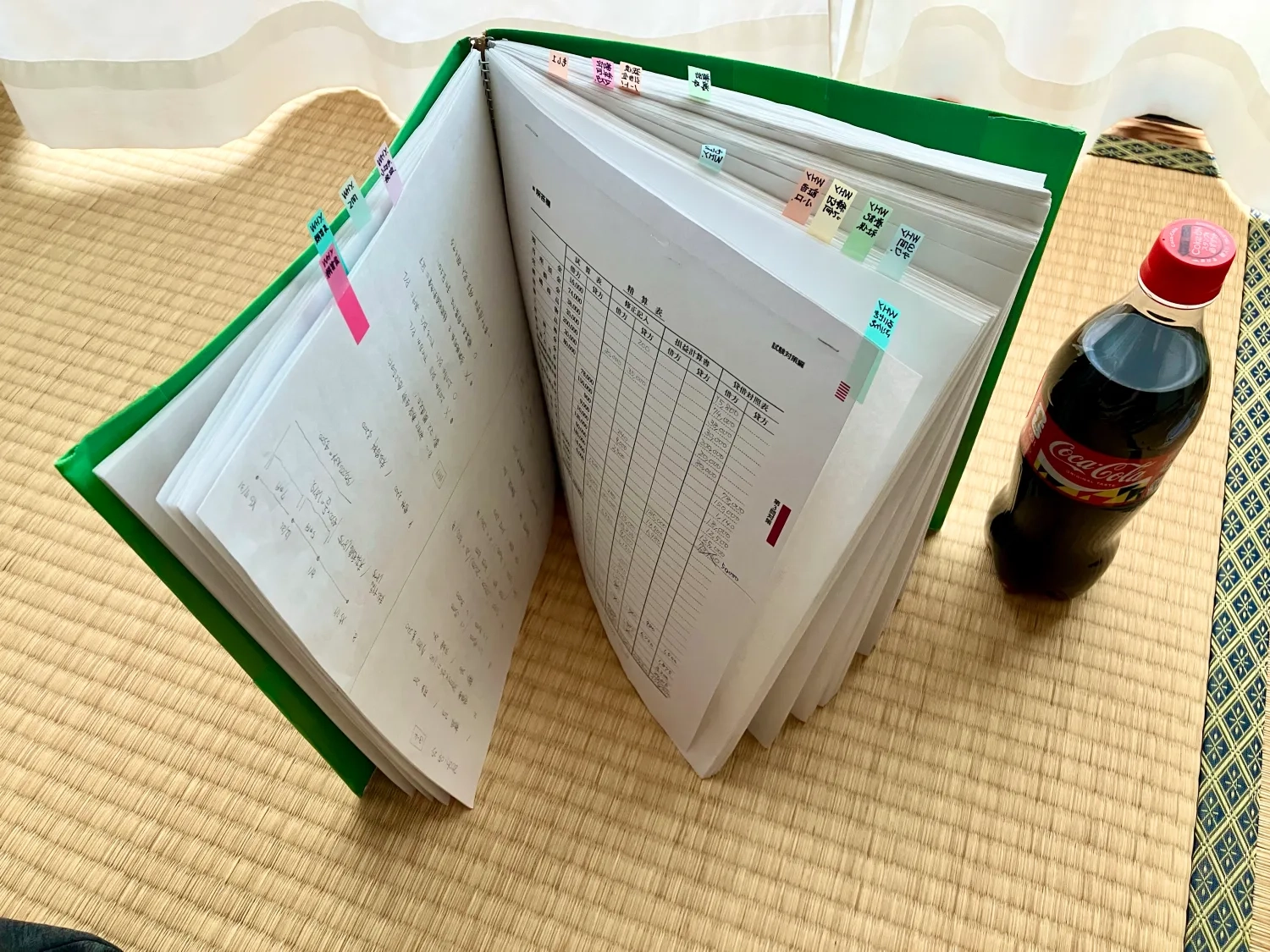
The amount I studied almost filled one whole croquis sketchbook. My friends burst out laughing and said, “You’re doing too much!! It’s Grade 3, you don’t have to go that far!!” “This isn’t EIKEN Grade 1!!” But for me, bookkeeping was an unknown world. It was interesting, and as I tried to understand it better, I just kept sinking deeper and deeper into studying it.
And then, the actual exam……
- I solved it in the order 1, 3, 2.
- There was clearly more volume than in the mock exams.
- Question 1: A 15-hit drill of journal entry questions. I answered everything in 18 minutes. But I got one question wrong. I really want to know what I got wrong……but I can’t check it…… That is the weak point of CBT.
- Question 3: Ten closing adjustment items + making the P/L and B/S. Depreciation split by month and accruals/deferrals appeared heavily, so it took me 31 minutes. I mean, if you are going to give me a “heavy type” question, keep the closing adjustments to about eight items! Still, I got 100% correct on this one, so I’m satisfied. When the net income number matched at the end, my excitement shot way up.
- Question 2: A problem where I had to fill in the accounts receivable ledger and the inventory ledger using the first-in, first-out method. For Question 2, I still haven’t fully covered all the question patterns (there are too many subsidiary books), so I struggle every time. After I finished the accounts receivable ledger, I had only two minutes left. I had almost given up on answering everything, but when I looked at the inventory ledger……this is super easy!! Whoa!! Fill it all in!! And I ran out of time right in the middle of that. I got 60% correct. The things I wrote were probably all correct.
- If you aim for a perfect score of 100, you probably need to cover all the patterns for Question 2. Then I would not have needed to spend time understanding the structure of the accounts receivable ledger, so maybe I could have answered all of Question 2 too.
- But the certificate is not really designed to show off your score, so I guess this is the kind of exam where the score does not matter that much. It is different from EIKEN. In EIKEN, passing is important too, but the score is pushed to the front quite strongly.
So Why Bookkeeping?
Until recently, I was studying for EIKEN.
I discovered that when I study, my brain gets tired and I can sleep well. My insomnia disappears. So one reason was that I wanted to keep a study habit.
Then I thought I would study mathematics next. First, I tried reading a book on the history of mathematics.
I liked the story about Pacioli in 15th-century Italy writing about double-entry bookkeeping in his own book. It seems that from more than 500 years ago until today, the basic structure of double-entry bookkeeping has hardly changed. So then……
- I thought Nissho Bookkeeping sounded boring, like “a qualification for work”, but was it actually “a field of study” that had crossed countries, societies, and ages?
- If it has hardly changed across societies and ages, maybe it is something fairly simple?
- But I sometimes hear that Nissho Bookkeeping Grade 2 and Grade 1 are difficult.
- What is the difficulty of bookkeeping? What exactly makes it difficult……?
……That is how I became interested. So I started.
Because I had that background, even when I felt something did not quite make sense while studying, I could keep going by thinking, “Still, this is a system that has survived all kinds of evaluation and stayed mostly unchanged for 500 years, so my understanding is probably just shallow, and bookkeeping is probably the one that is right……” It was fun.
Also, quite a few of my friends have Bookkeeping Grade 3, so it is fun that we now have more things to talk about.