Overview
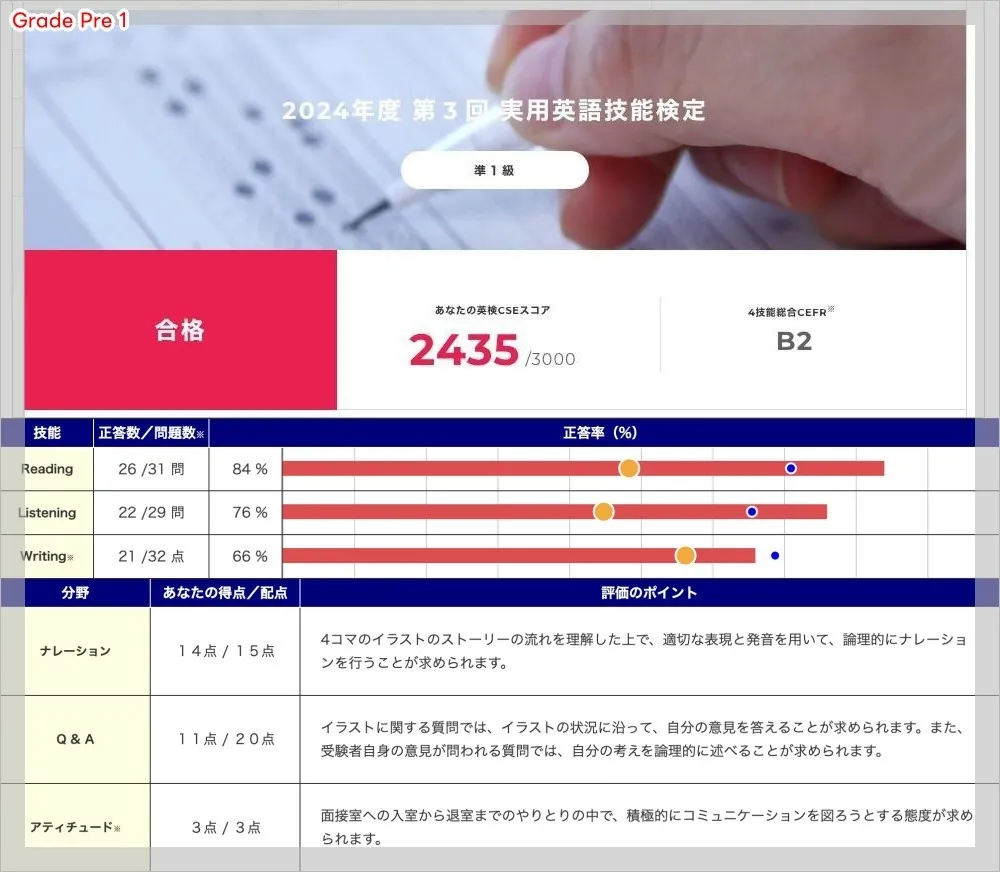
One year ago, I passed Eiken Pre-1.
And now, one year later, I passed Eiken Grade 1.
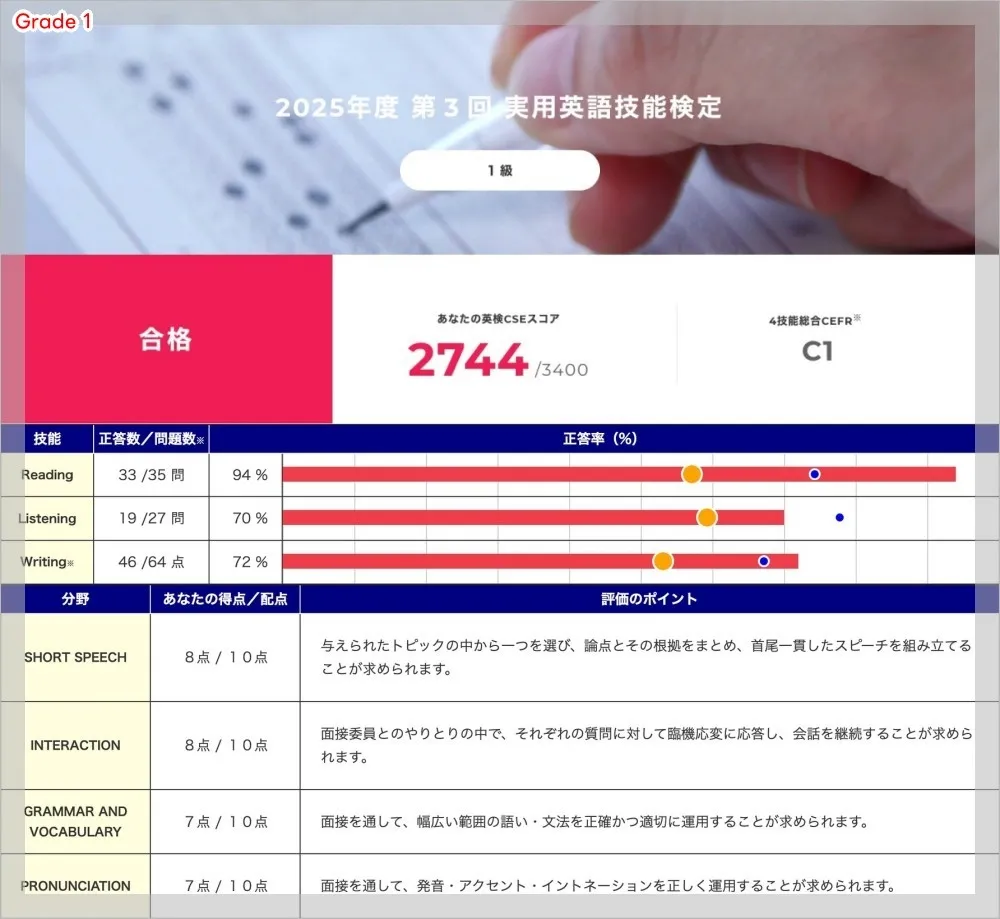
I don’t use English in daily life or at work. So this one-year study record should be pure information needed for passing the first stage of Eiken Grade 1. I’m writing this with the idea that a record focused only on studying itself has some value.
A quick note to readers: this article is very long.
I did consider splitting it into multiple posts, but from my own experience as a reader, it’s more useful to have everything gathered on a single page. So this time, I’ve decided to present it in this format.
Outline
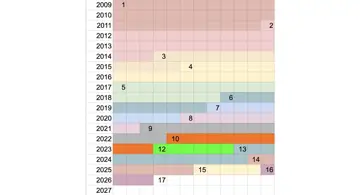
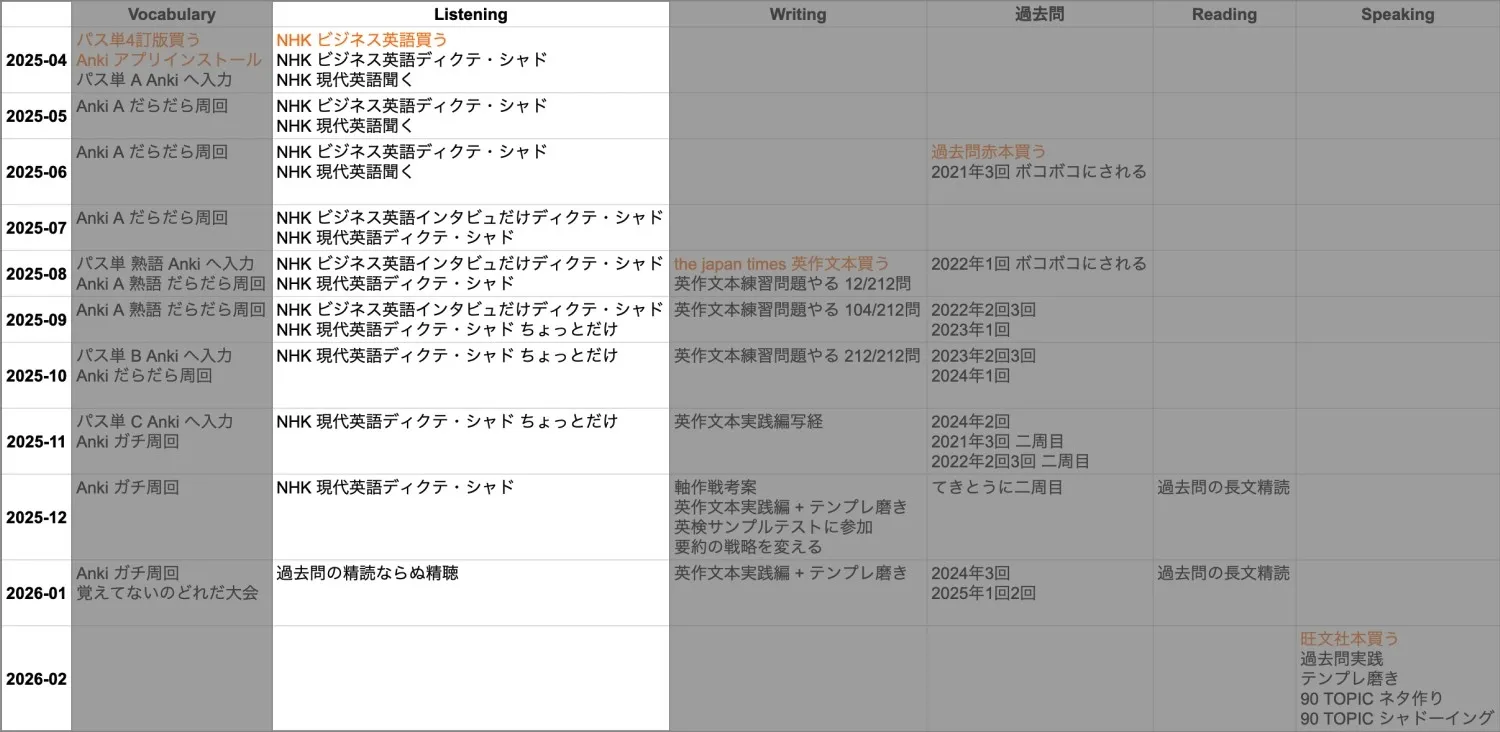
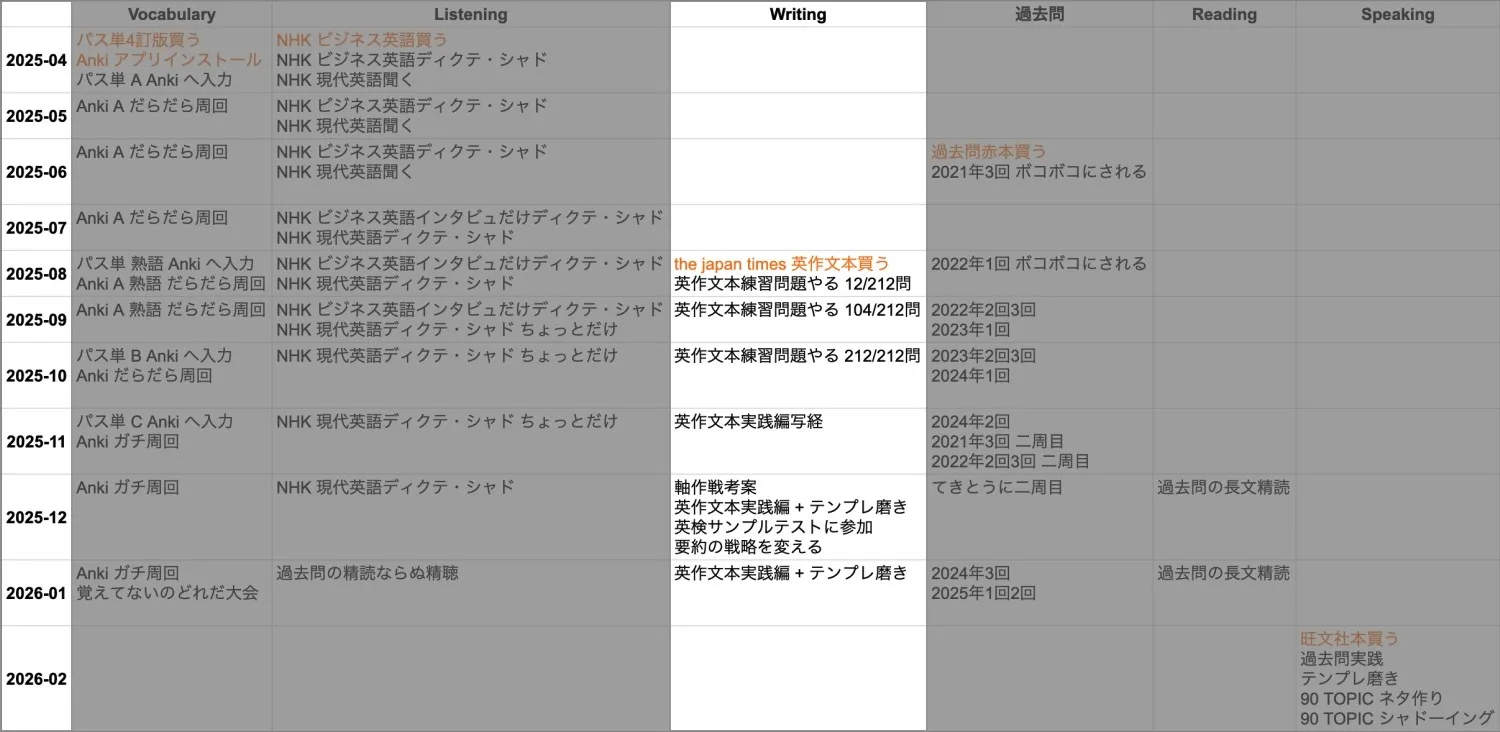
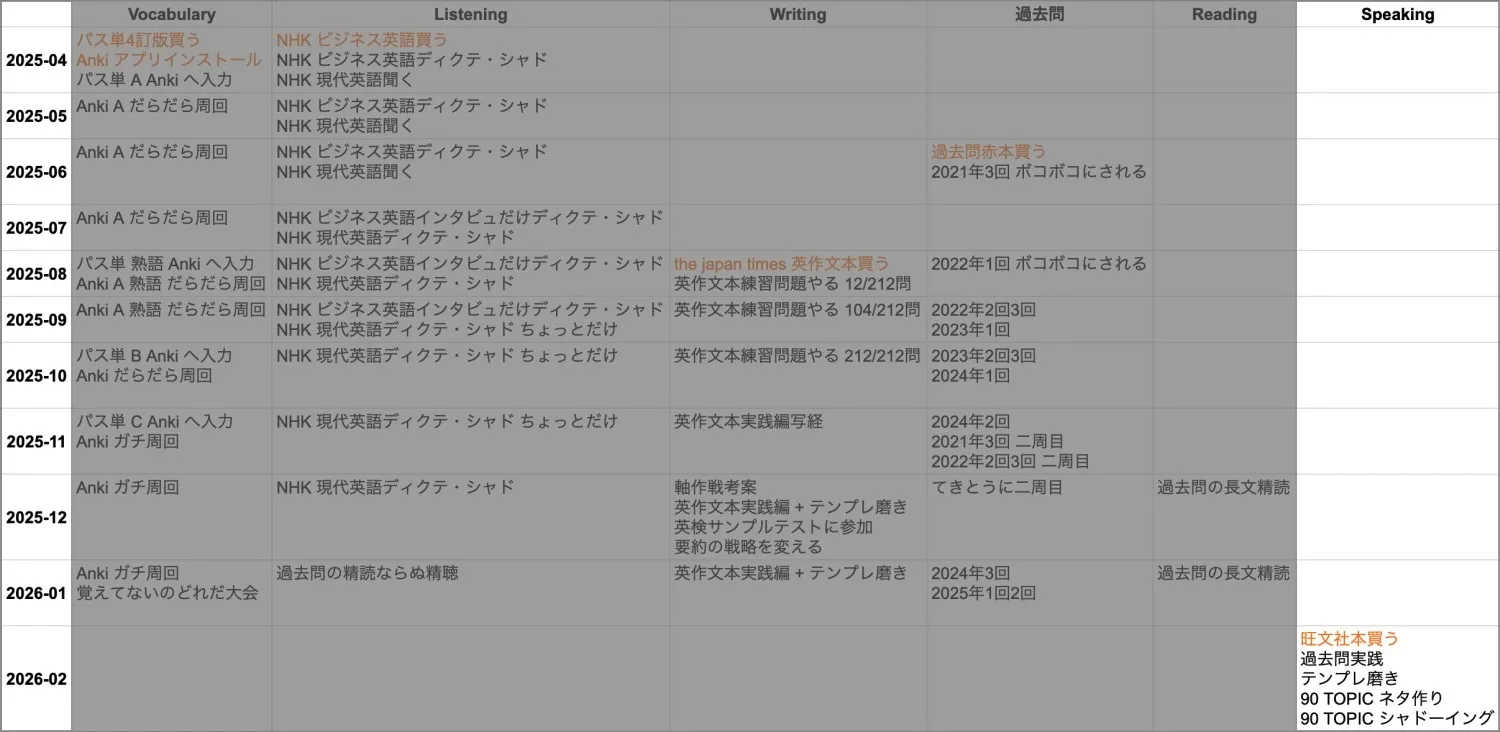
This is what my one year looked like.
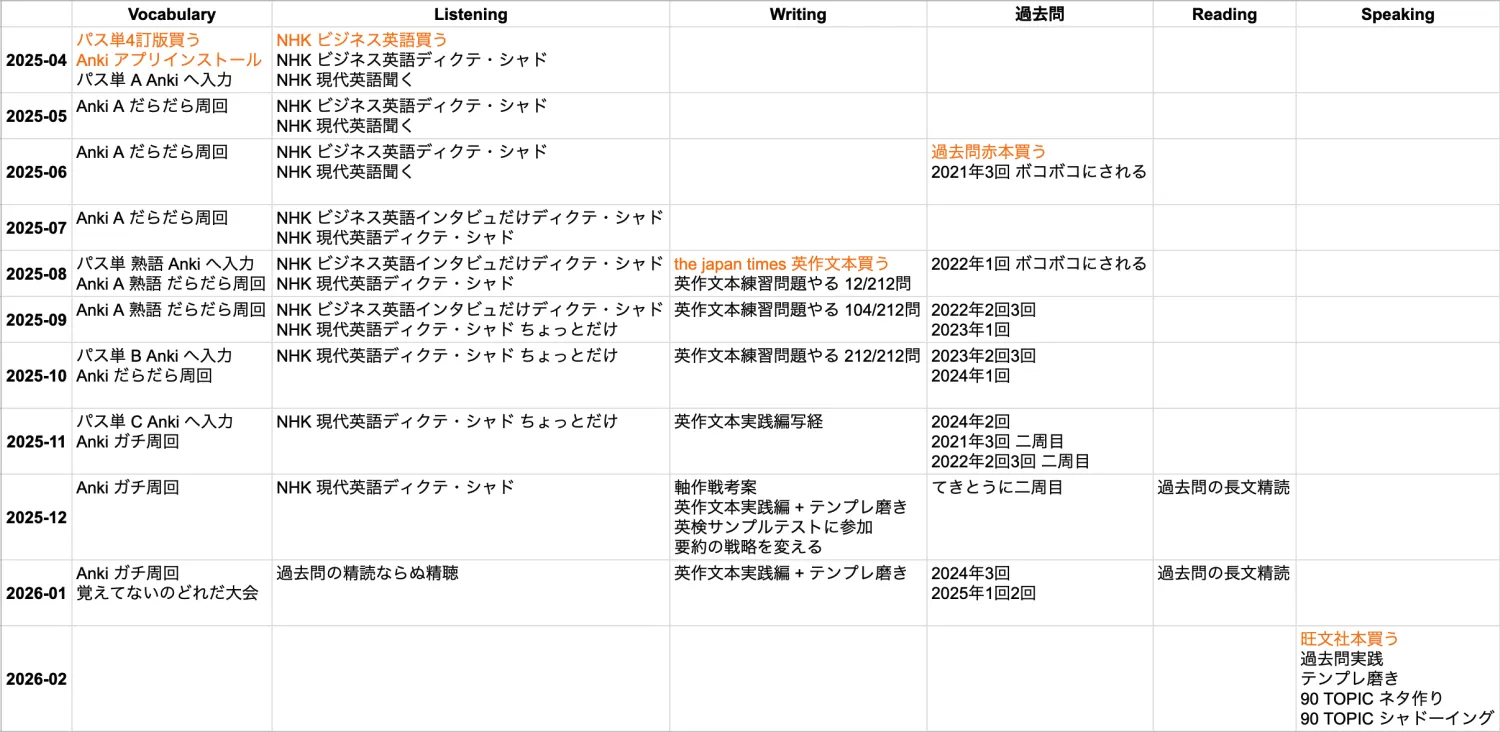
I wondered how to structure this, but it’s probably easiest to write by category… Vocabulary, Listening, Writing, Past Exams, Reading, and Speaking.
Vocabulary
Vocabulary is my strong area! I only missed one question in Reading Part 1, so this method is probably working.
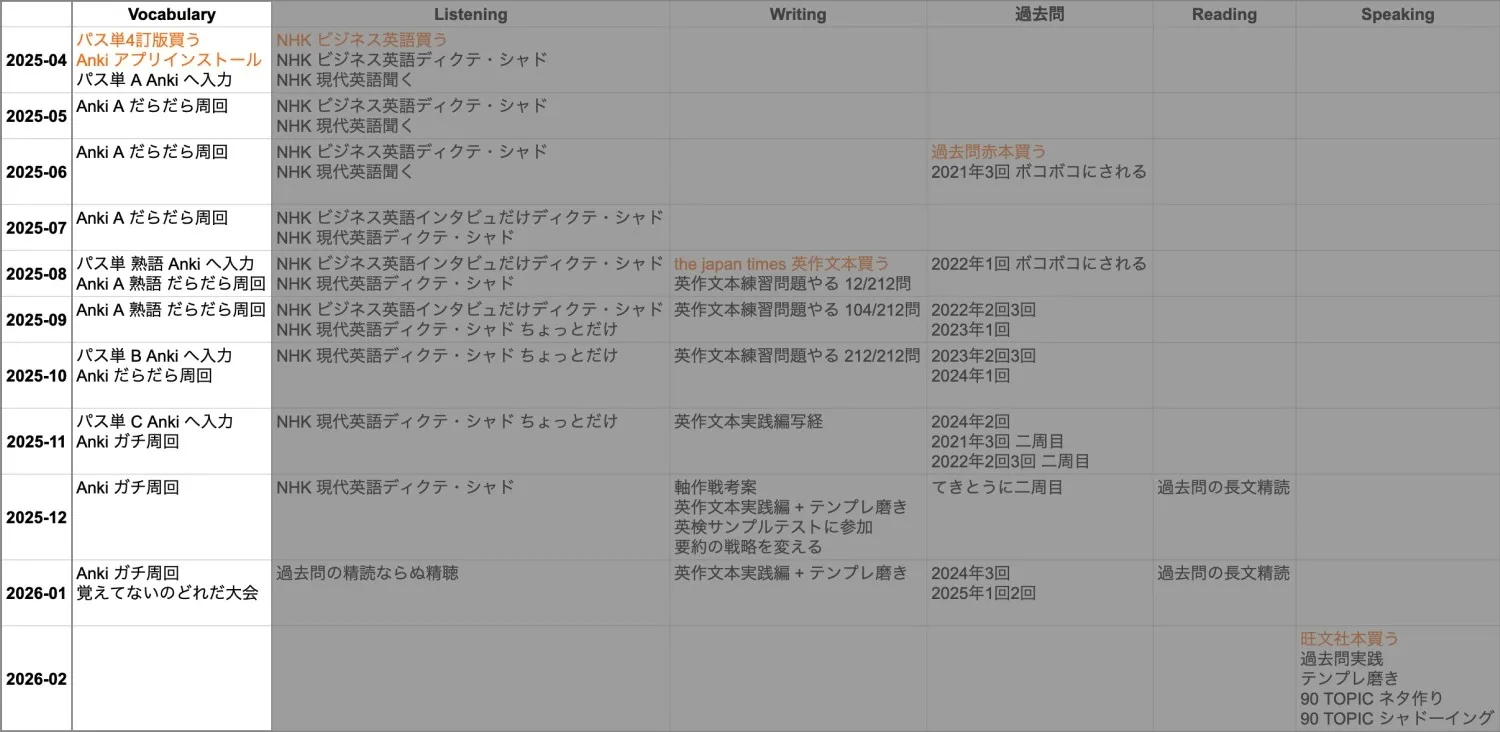
What to prepare
- Deru Jun Pass Tan Eiken Grade 1 (4th Revised Edition) (https://www.obunsha.co.jp/product/series/f035)
- Note: The 5th revised edition is easier, so look for the 4th edition as a used book.
- Anki app (https://apps.ankiweb.net/)
- Note: An app that lets you share flashcards across Mac, Android, and iOS.
What to do - Prepare flashcard data
Load data into the Anki app like this ↓
- Take photos of all pages of the vocabulary book
- Give the photos and the following prompt ↓ to ChatGPT, and convert the book into text data
## Task Overview

Take images of an English vocabulary book, extract the information, and output it in Anki.app text format.

## Specific Tasks

1. For each English word, get the following information
    - Left page
        - Word number
        - Main English word
        - Phonetic symbols
        - Japanese meaning, related words, etc.
    - Right page
        - Example sentence
        - No need to include the Japanese translation of the example
2. Output in Anki.app text format
    - Note: Replace `<TAB>` with an actual tab character

```plaintext
#separator:tab
#html:false
Headword<TAB>Word number, phonetic symbols, Japanese meaning, related words, example sentence<TAB>Frequency_C
Headword<TAB>Word number, phonetic symbols, Japanese meaning, related words, example sentence<TAB>Frequency_C
...
```
- Then it generates text like this ↓
#separator:tab
#html:true
smear   1603, [smíər], to spread, to slander (someone’s reputation), ▶ smear campaign, The man smeared butter, then honey on a chunk of bread.
vigilant    2094, [vídʒələnt], careful, watchful, The politician was known as a vigilant defender of human rights.
...
- Convert all pages into text data like this ↓
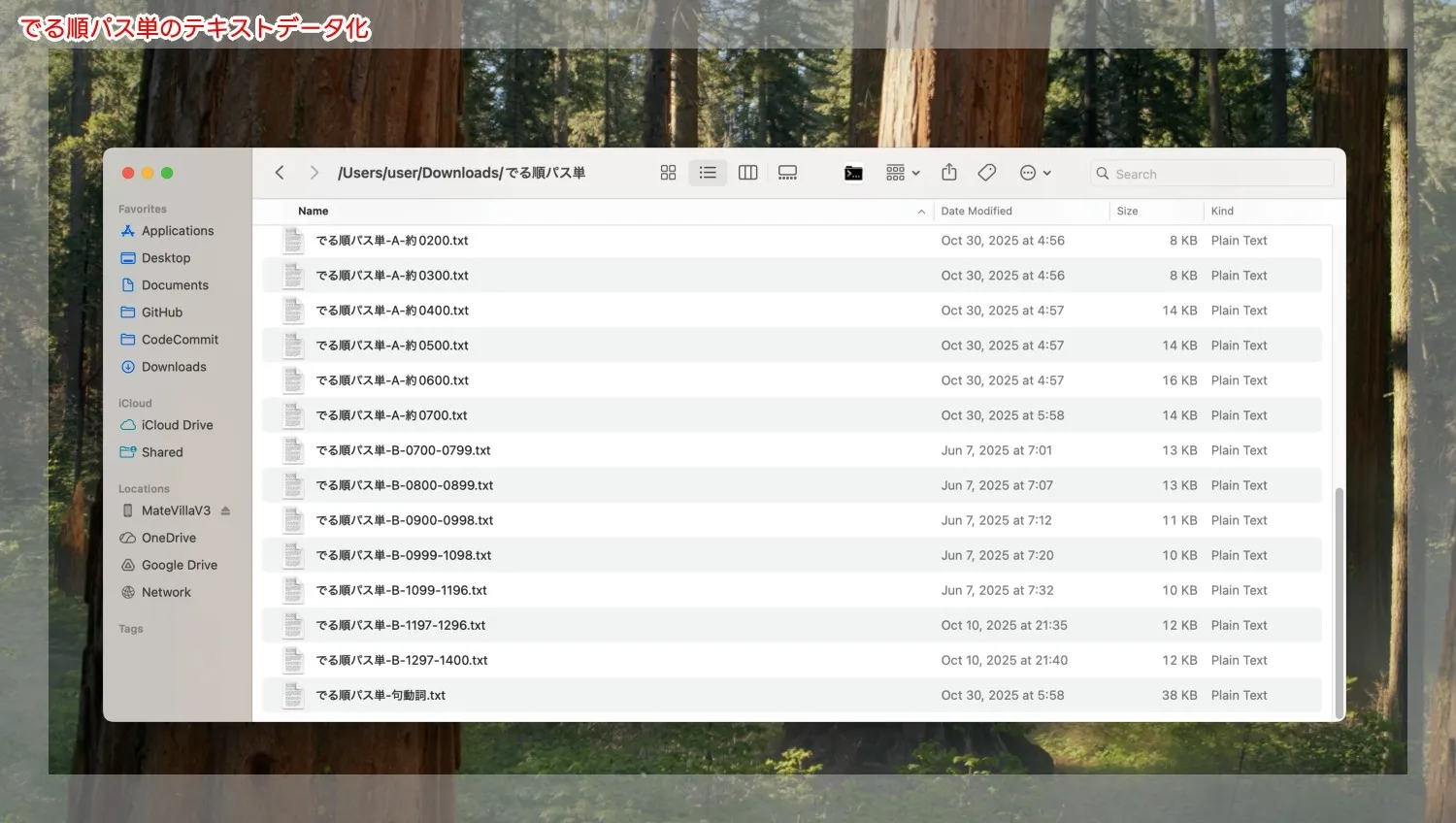
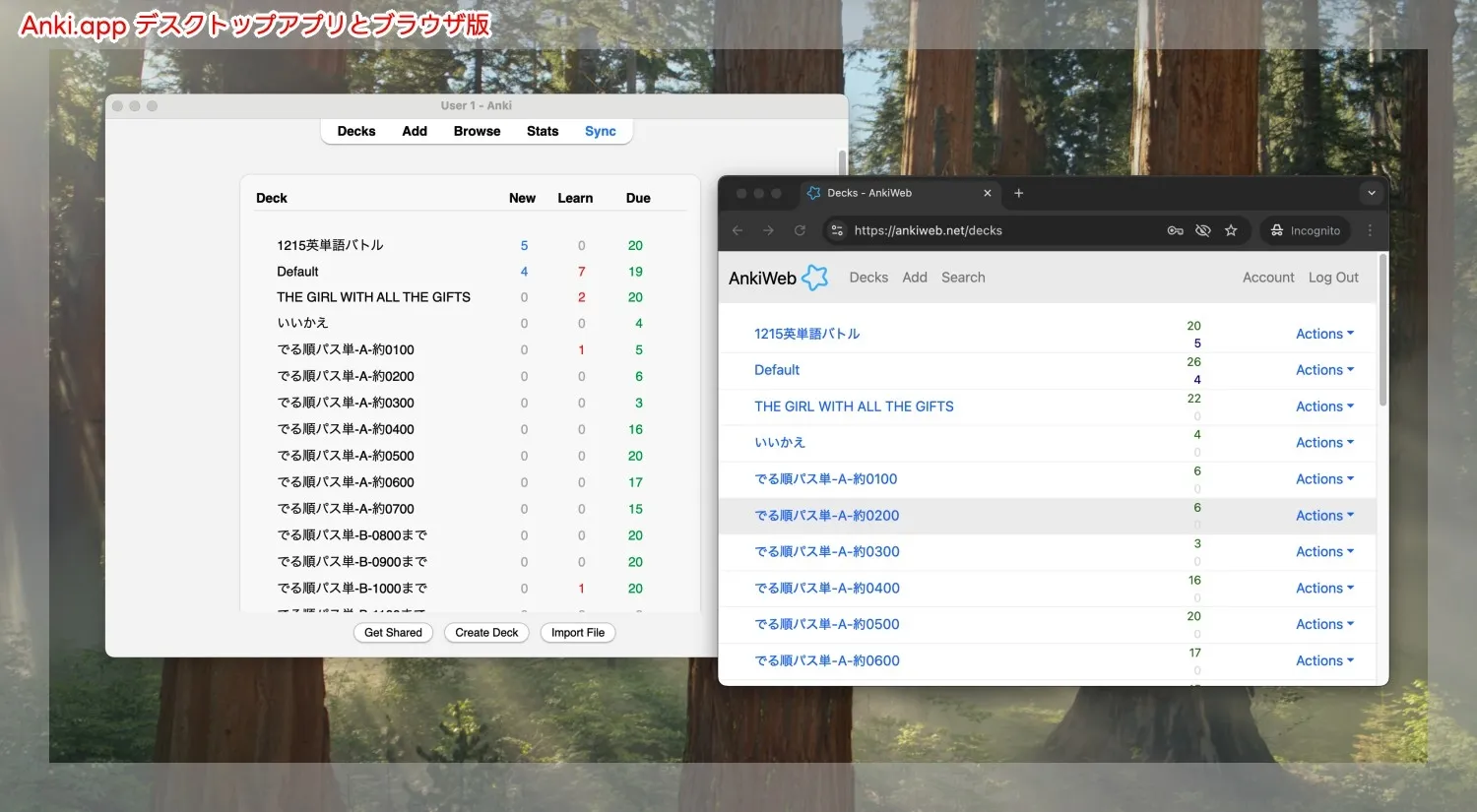
- Import the text into the Anki app, and it looks like this ↓ Now you can review words anywhere as long as you have a PC or smartphone.
What to do - Review flashcards
- Go through everything, and for words you can’t instantly recall, create your own original association game and write it into the card
- For example… when I see the word snitch, I think of the snitch in Harry Potter
- So I imagine Potter grabbing the snitch → “grab”
- I write this into Anki
- Do this for all 2,400 words in the book
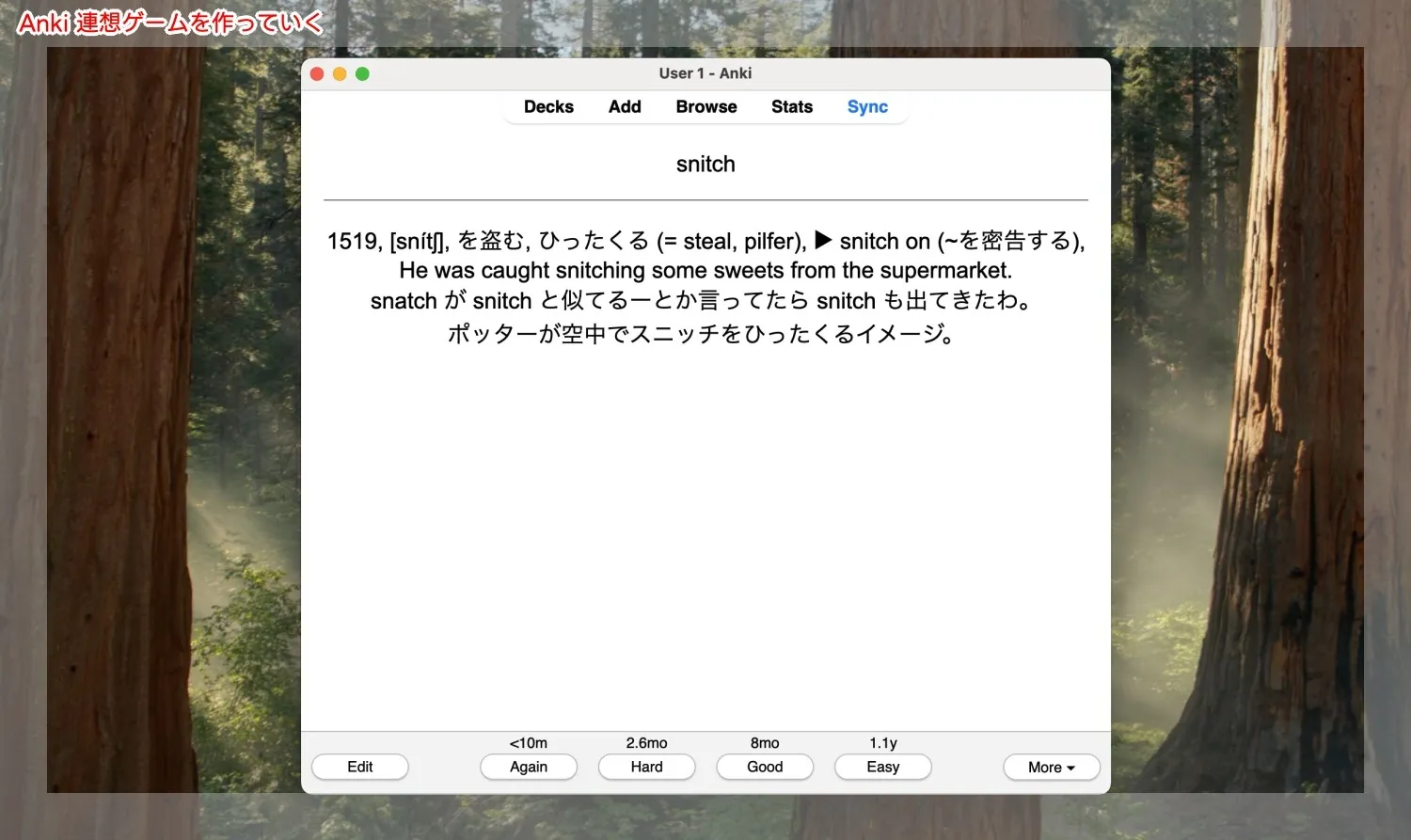
- Keep reviewing these original association games to memorize words
- If you think “there’s a better association,” edit it and improve it over time
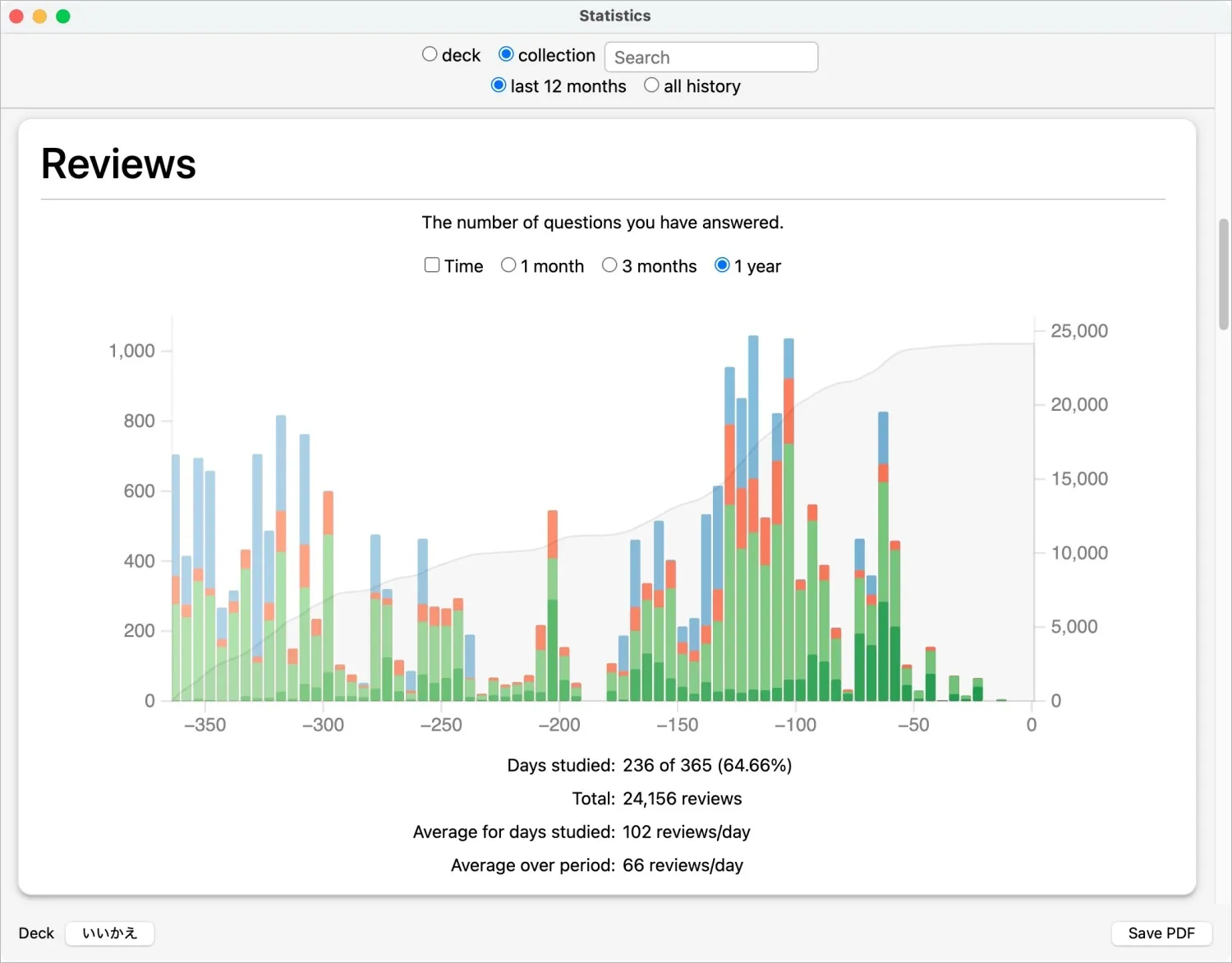
Looking at it now, I reviewed flashcards about 24,000 times in a year. Huh, that means about 10 full cycles.
Thoughts
- The “association game” is based on “the image that instantly comes to your mind when you see the word,” so you have to create it yourself
- After finishing this, you’ll know about 92% of the vocabulary (as of 2026-01 ↓)
- Personally, I think no more vocabulary study is needed beyond this
- “I saw a word I didn’t know in Part 1!!” → If it’s not in Pass Tan, you don’t need to learn it
- “I saw a word I didn’t know in a long passage!!” → No need to learn it. Eiken reading passages are well designed, so you can solve them even if you don’t know one or two words. Also, even in Japanese, we don’t look up every unknown word—we just skip them. No need to do in English what you don’t do in Japanese.
- On the other hand, Grade 1 vocabulary appears in reading and listening too, so studying vocabulary first is necessary
Listening
Listening is my weak area! I only got 70%, which is below the average of those who passed. So my method might not be appropriate.
What to prepare
- Install Rakuraji 2 (https://dogaradi.com/らくらじ/)
- Note: You can listen to and download NHK radio
- Another note: The official NHK app “Rajiru Rajiru” somehow lacks offline download. Not suitable if you want to save data usage
In “Rakuraji 2,” bookmark these programs ↓
- NHK Radio Business English (https://www.nhk.jp/p/rs/368315KKP8/list/)
- You can buy a monthly textbook at bookstores
- NHK “Current English” from the News (https://www.nhk.jp/p/rs/77RQWQX1L6/list/)
Then, do dictation & shadowing of these every weekday.
What to do
- (First half of the study period) Do dictation & shadowing of “Business English” every weekday
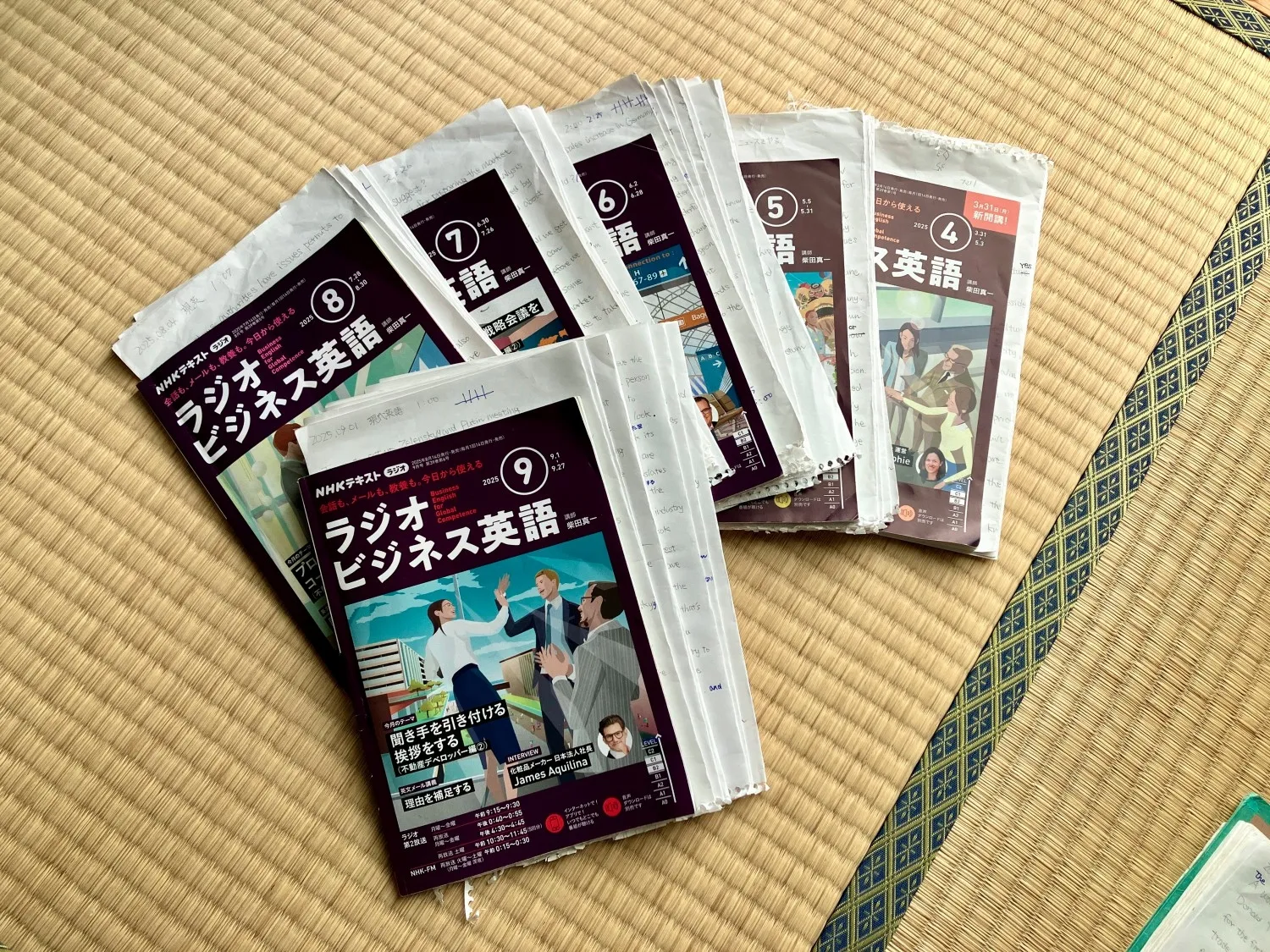
- (Second half) I started to prefer “Current English” over “Business English,” so I switched to doing that every weekday
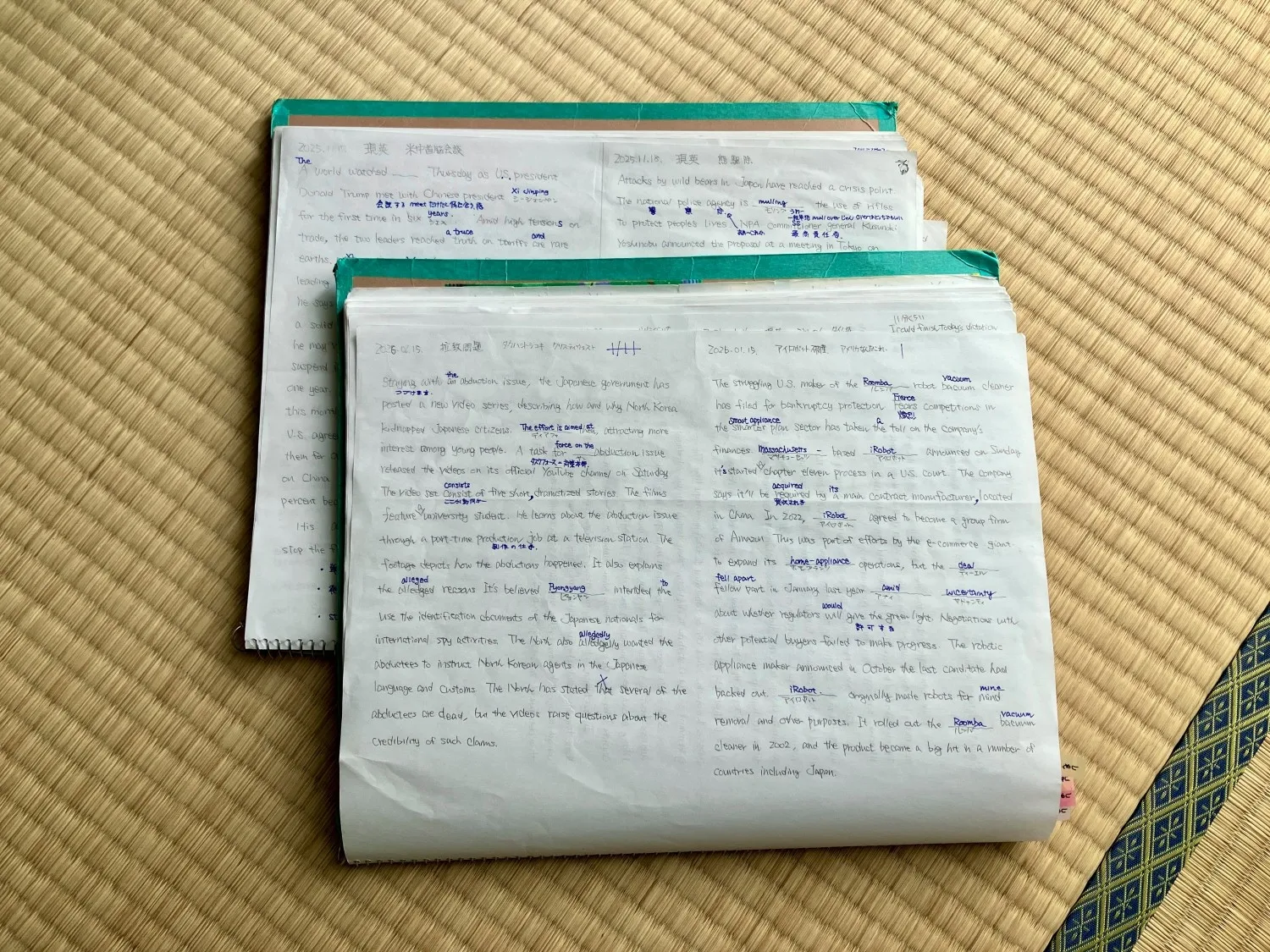
- (About 2 weeks before the exam) Do “deep listening” of past exam questions
- Pick one question you can’t understand even after listening multiple times
- Identify why you couldn’t understand it (I call this “finding the why”)
- Fix the cause so you can understand it in one go next time
What to do during the exam
- Part 1: Listen while drawing the situation in the air. When you “draw,” you can focus without distractions. If you just listen, your mind wanders! At first, I drew on paper, but that takes too much time. So I move my mechanical pencil in the air and draw in my head. This is my secret technique.
- Part 2: Same—draw the situation in the air
- Part 3: For Part 3, I look at the choices while listening, marking “this is wrong” as I go
- Part 4: For Part 4, it’s too much to remember by drawing in the air, so I take quick notes
General mindset ↓
- Even if you get lost and don’t know the answer, mark all the options that are clearly wrong. If three choices are crossed out, the remaining one is correct
- Always keep track of the subject of the sentence you are hearing. I think the subject is the most important. Always ask, “Who is this about right now?”
And one thing to watch out for in the real exam ↓
- Sit in the very front row
- I’ll explain this later in the first-stage section…
Thoughts
- Looking back, my listening method still feels unstructured
- I should have spent more time on “deep listening.” The deep reading I did for reading practice was very helpful, so listening should be similar
- Anyway, for someone who doesn’t use English in daily life or work, this method gets you about 70%
Writing (Essay)
For essay writing, I had no clear idea what the scoring criteria really were, so throughout my study period I kept thinking, “Is this really okay...?” Still, I got 30/32, so the method was probably right.
What to prepare
- The Japan Times - Pass Eiken Grade 1 in the Shortest Time! Mastering the Writing Test (https://bookclub.japantimes.co.jp/book/b309521.html)
One note here. This article is meant to record the path I actually took, so I have to introduce this 2016 book ↑. But next month, in 2026-04, a new one will come out for the first time in 10 years! And this time it properly includes summary practice! Lucky. So from now on, this one ↓ will probably be the better recommendation.
- The Japan Times - Pass Eiken Grade 1 in the Shortest Time! Mastering Summaries and Writing (https://bookclub.japantimes.co.jp/book/b673866.html)
What to do - How my study changed over time
Here, I want to write about how I gradually reached the point where I could finish an essay in 25 minutes. Some parts were probably wasteful (and this will probably be long...), but it means a lot to me, so I want to leave it here.
- [Steady work] I steadily worked through the first half of the The Japan Times book, the practice section. The style was like looking at Japanese sentences and translating them into English. I kept doing this almost every day from 2025-08-24 to 2025-10-29, and solved 212 questions. To be honest, this did not build the ability to squeeze POINTs out of a TOPIC, which is necessary for the Grade 1 writing task. Still, I feel it gave me a sense of things like this ↓
- Kind of... a feel for using participial constructions
- Kind of... a feel for avoiding repeating the same word
- Kind of... a feel for how long one sentence should be
- Writing 212 pieces of English composition gave me this sort of feel for the area, and I think that is one way to use this book
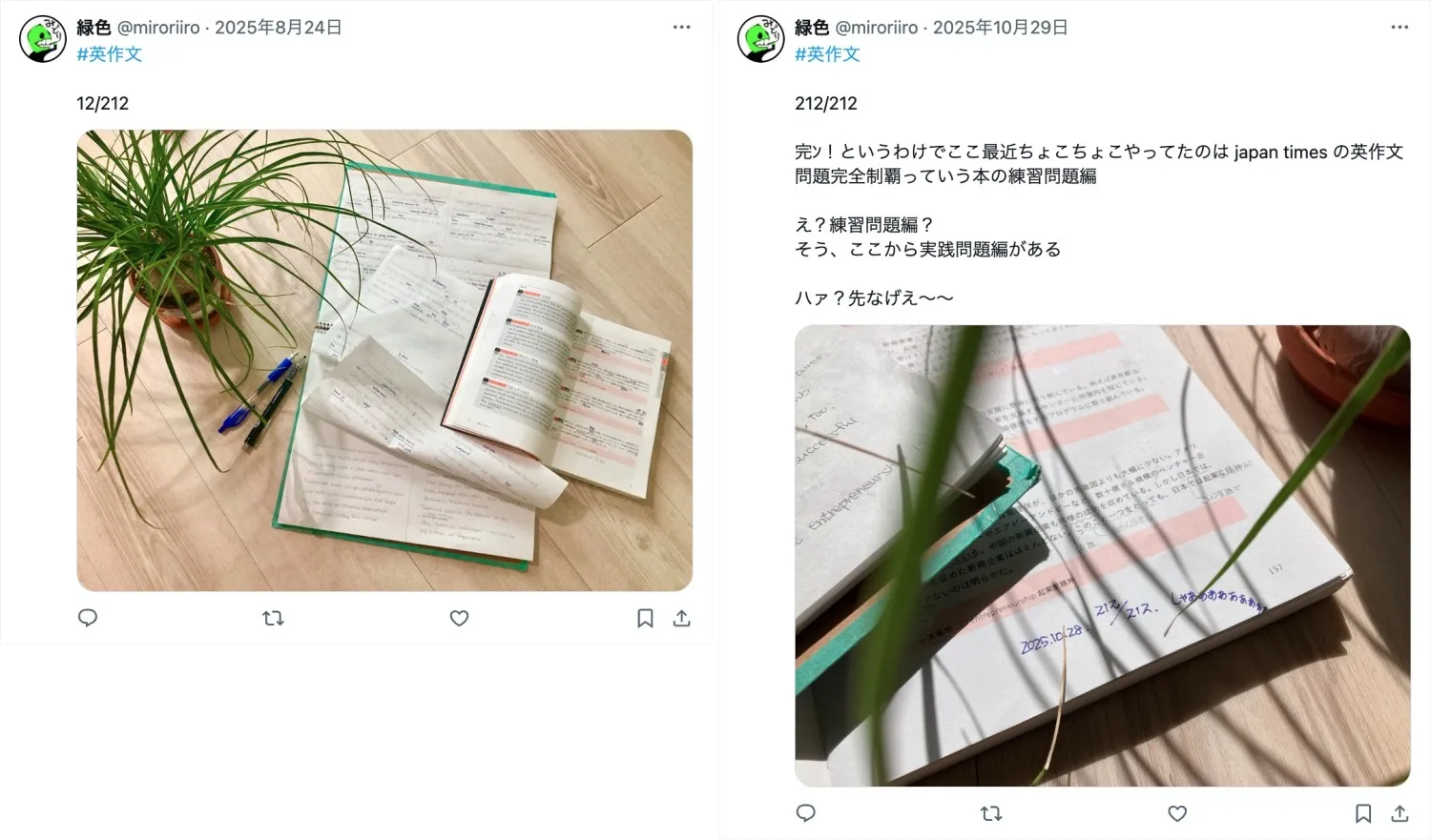
- [The problem of having nothing to write] Then I moved on to the second half of the The Japan Times book, the practical section... but because I didn’t have the ability to squeeze POINTs out of a TOPIC, even if I had the power to translate into English, I couldn’t come up with ideas, and everything looked hopeless. This period was pretty hard. I wanted to write, but I had nothing to write.
- [Creating a strategy] So I came up with what I call the “axis strategy.” The idea is that no matter what the TOPIC is, if I think in terms of one of these axes—globalization, innovation, environmental issues, population issues, the economy, tradition, or people’s interests—I can usually find some kind of merit and demerit. So when I worked on essay writing, I first quickly wrote these down on paper, came up with ideas that could connect to the TOPIC... and then used those ideas as POINTs for the essay. I liked this strategy a lot because I invented it myself.
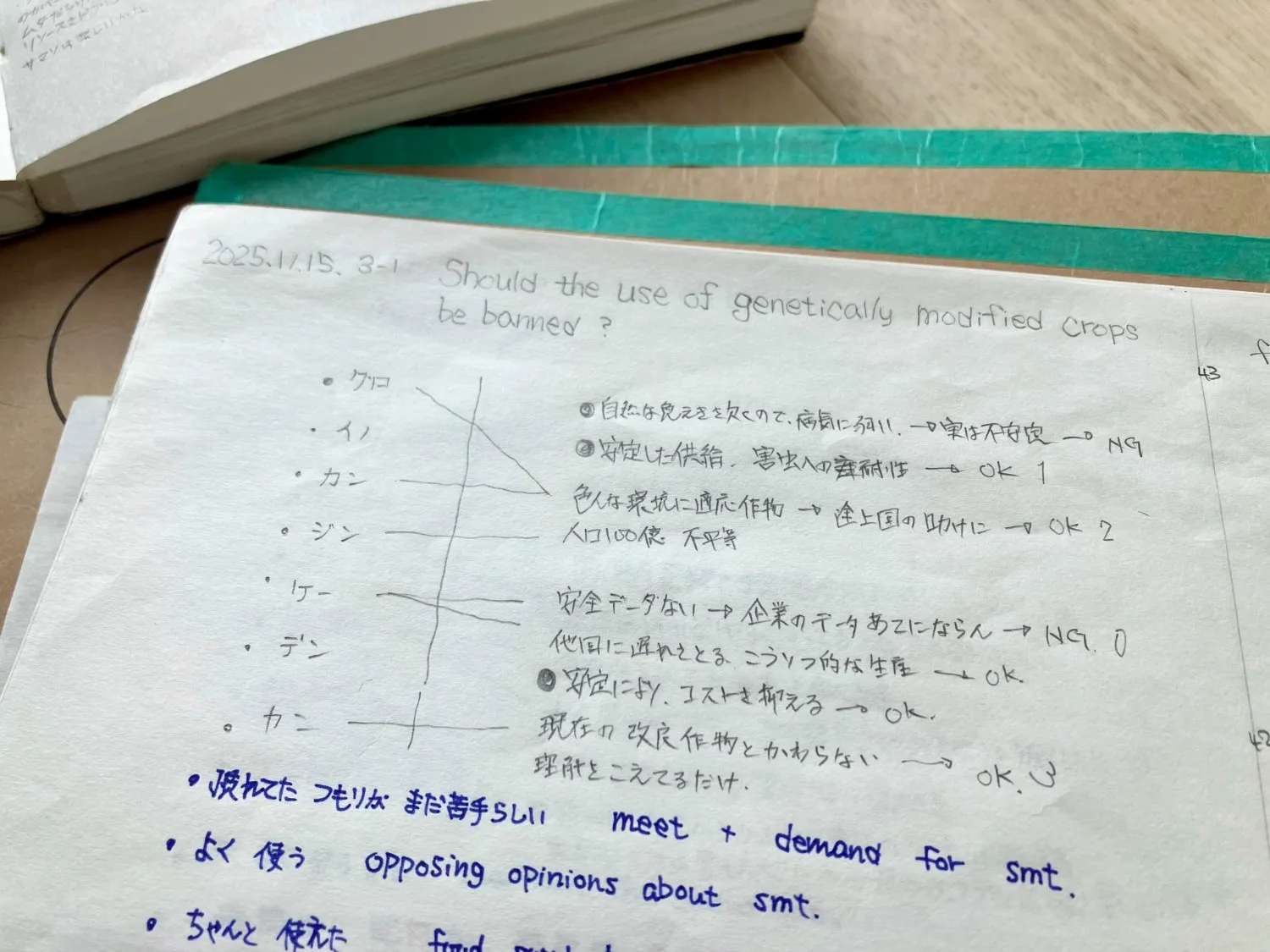
- [The problem of taking too much time] But there was still another problem. At that time, I was taking about 40 minutes to write one essay, and considering the total exam time for Grade 1, that was clearly too long. If you compare the exam time and the number of questions, essay writing obviously needs to be done in 25 minutes. Could this be some kind of mistake...? How much do you have to improve before you can write at nearly double speed?
- [Do the axis strategy in my head] I stopped writing out the axis strategy. I had to do it in my head. This may have saved... about five minutes. Still a long way to go.
- [Starting to refine templates] Around this time, I started researching the strongest possible writing template. The body changes a lot depending on the TOPIC, so it is hard to turn into a template, but I thought I could template the introduction and conclusion so I wouldn’t spend time writing them. My template around that time was probably something like this.
Introduction:
Some people would argue that ...
However, I am of the opinion that ...
because 3 reasons rephrased here.

Body 1:
Try hard and write

Body 2:
Try hard and write

Body 3:
Try hard and write

Conclusion:
Based on the points mentioned above, I believe ...
- [A word from a comrade-in-arms] Around this time, I met another learner who was also challenging Grade 1. The topic was essay writing.
- Comrade: How do you come up with POINTs?
- Me: I use something called the axis strategy in my head... and so on and so on
- Comrade: I do my best to squeeze out two, but the third one is hard to find. So when that happens, I make Body 3 by deliberately preparing a counterargument and then denying it. That way I somehow gather three POINTs...
- Me: I see, I see
- [Template completed] Wait a second. Couldn’t the sentence structure for deliberately preparing a counterargument and then denying it be turned into a template? If so, the introduction, Body 3, and conclusion could all become almost fully templated. Around this time, I also started using the strategy of leaving about five lines blank for the introduction and filling them in only after writing everything else. That feels easier.
Introduction (fill in last):
While some people contend that ...,
I am of the opinion that ...
because Body 1 and 2 rephrased here.
Furthermore, many counterarguments rest on questionable assumptions.

Body 1:
First, ... try hard and write

Body 2:
On top of that, ... try hard and write

Body 3:
Some would argue that ...
This argument, however, has several flaws.
Try hard and write

Conclusion:
In conclusion, although ... may bring some tangible advantages/drawbacks,
when taking the points mentioned above into consideration,
it becomes evident that ... is
[more beneficial than detrimental]
/[partly beneficial rather than entirely detrimental].
- [25 minutes] And so, the time I spent on essay writing finally reached 25 minutes. The way to shorten 40 minutes to 25 minutes was to expand, as much as possible, the sections where I could move my pen without thinking (the template).
- Having more sections where I can move my pen without thinking also means having fewer sections where grammar mistakes can happen. (A great deal)
Whew... this part means a lot to me, so it got long. But in English composition, you still need both the ability to translate what you want to say into English and the ability to avoid childish writing if you want a high score. So I handled that like this.
What to do - Study to avoid childish English writing
- Take a photo of the English composition you wrote.
- Send the photo and the following prompt ↓ to ChatGPT, and ask for correction.
## Your role

Please act as a scorer for Eiken Grade 1 essay writing! Specifically, do the following.

### 1. Receive an image

- I will give you the user's answer sheet as an image

### 2. Turn it into text

- At the top left of the image is this time's TOPIC
- Below that are my notes for writing the essay. You can ignore those
- Everything after that is the essay

### 3. Count the words

- Use Python to measure the essay's word count accurately
- In Eiken Grade 1 essay writing, the word count must be between 200 and 240
- However, this measurement is known to have an error of up to 5 words, so going over by that amount can be ignored

### 4. Correct it

- Assume the English level is that of the Eiken Grade 1 exam
- Point out major grammar mistakes, inappropriate word choices, and expressions whose meaning is seriously off
- Also, please mention sentences that are written well
- Separate the feedback sentence by sentence (introduction 1, introduction 2, body 1-1, body 1-2, etc.)

### 5. Try scoring it

- Eiken Grade 1 English composition is scored out of 32 in total, with 8 points each for content (whether it includes what the task asks for, an opinion, and reasons supporting it), organization (whether the structure and flow are clear and logical), vocabulary (whether vocabulary appropriate to the task is used correctly), and grammar (whether there is variation in sentence structure and whether it is used correctly)
- Repeat this, and collect the following:
- Correct English versions of expressions I often want to write
- Grade 1 level paraphrases for vocabulary I often want to use
- Grade 1 level paraphrases for grammar patterns I often want to use
- Make a list of those ↑. For example...
- On top of that, A case in point, be attributed to, and so on
- Then write English compositions while trying to use as many of those as possible. Interestingly, when you try to write using high-level grammatical structures, those structures themselves lead the writing and make translation a bit easier. It’s easier to think, not “How should I translate what I want to say into English from zero?” but rather “How can I fit what I want to say into the grammatical structure I want to use?”
- In this way, I wrote about 100 pieces in total, counting both the summary part and the essay part.
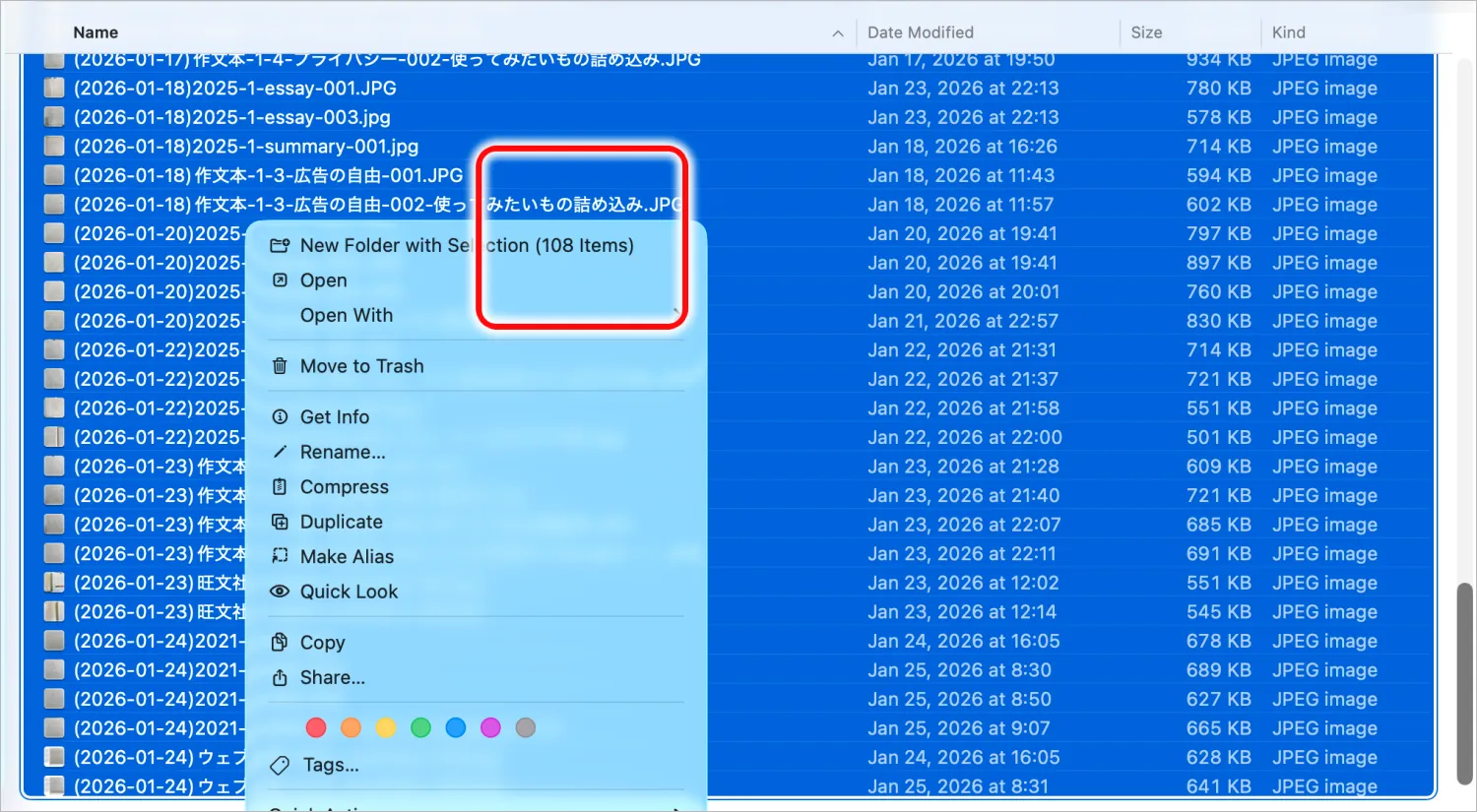
By the way, what I stared at right before the exam was the list of “Grade 1 level paraphrases for the kinds of things I often want to write.”
Thoughts
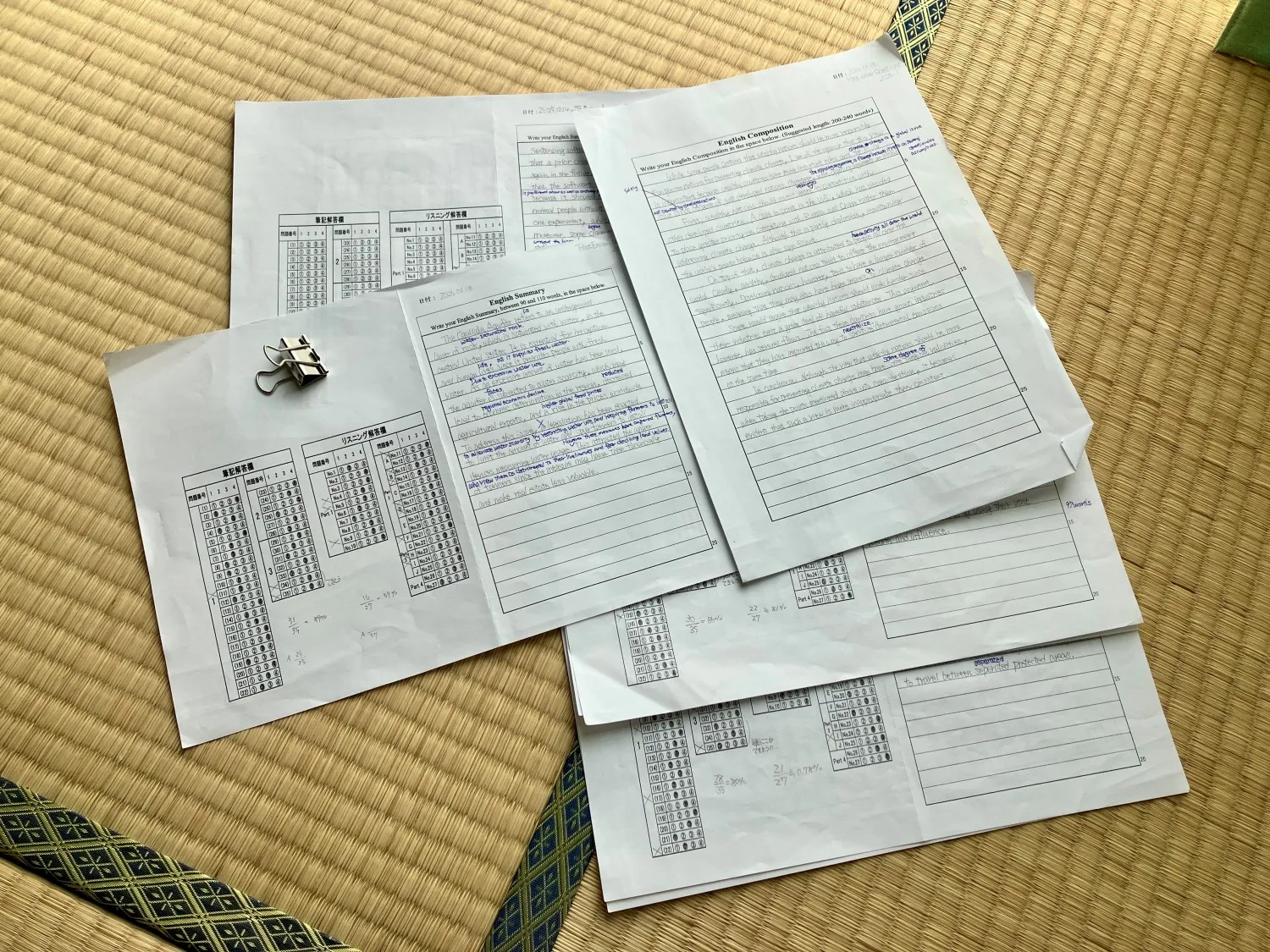
- Another thing I absolutely have to mention in the writing section is the word limit. You should know about how many words you write per line and how many lines you need in order to stay within the required range.
- In my case, for essay writing, if I filled about 5 lines for the introduction, 4 to 5 lines for each body paragraph, and 4 to 5 lines for the conclusion, for a total of 22 or 23 lines, I would be within the word limit.
- To get that feel, it’s better to find a sample answer sheet online and use it.
Writing (Summary)
My score on the summary part was 16/32. So my study method may not have been appropriate. Still, the summary section of 2025 Round 3 has caused a lot of controversy, so I think judgment should be reserved.
What to prepare
Nothing in particular, or rather, the same as for essay writing.
What to do
For the summary part too, I’ll briefly write about how things changed until I became able to finish it in 20 minutes.
- At first, my method was simply to read the whole passage quickly, make short bullet-point notes in Japanese, and then translate them into English so the number of words stayed within the required range. But even then, it still took about 30 minutes. (The ideal time for the summary section is 20 minutes.)
- Then I joined the little-known Eiken Sample Test, and that changed my strategy. The sample test I took included vocabulary questions and summary questions. At that time, I could hear the other test takers around me already starting to write their answers while I was still reading through the whole passage. I thought, “Oh, I see, so in the summary section, people just keep writing paragraph by paragraph?” That makes sense, because if you wait until after reading the whole passage, you forget useful expressions from the text that you could have used in your answer. From then on, my strategy for the summary section became this ↓
- Read one paragraph
- Quickly write a one- or two-sentence summary memo in Japanese (really rough)
- Translate it into English and write it down
- Repeat this through paragraph 3
- As my essay writing got faster, this part also naturally came down to about 20 minutes. My writing policy here was the same as in the essay: translate my summary notes into English while trying to use “Grade 1 level paraphrases for the kinds of things I often want to write” as much as possible.
At that time I was still only a Pre-1 holder, and yet the Eiken Sample Test I joined was for Grade 1. It became a very good mock test, and it was fun to steal strategies from fellow challengers! My score on the sample test was as follows.
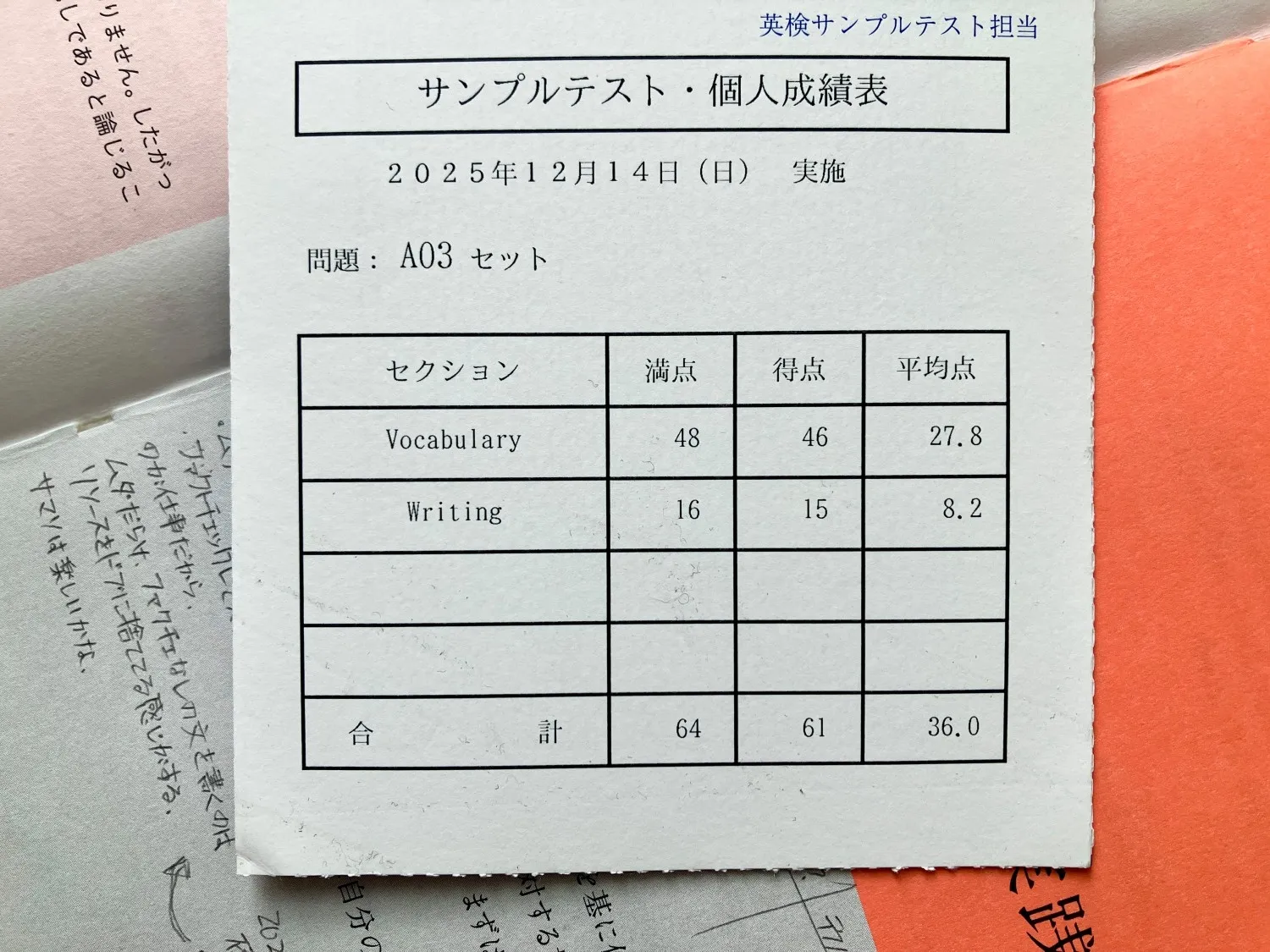
I got 46/48 on the vocabulary questions and 15/16 on the summary question. Since my actual summary score was 16/32, it really feels as if the scoring criteria clearly changed.
Thoughts
- Another thing I absolutely have to mention in the writing section is, just like with essay writing, the word limit.
- In my case, for summary writing, the whole answer was 13 lines.
Past Exams
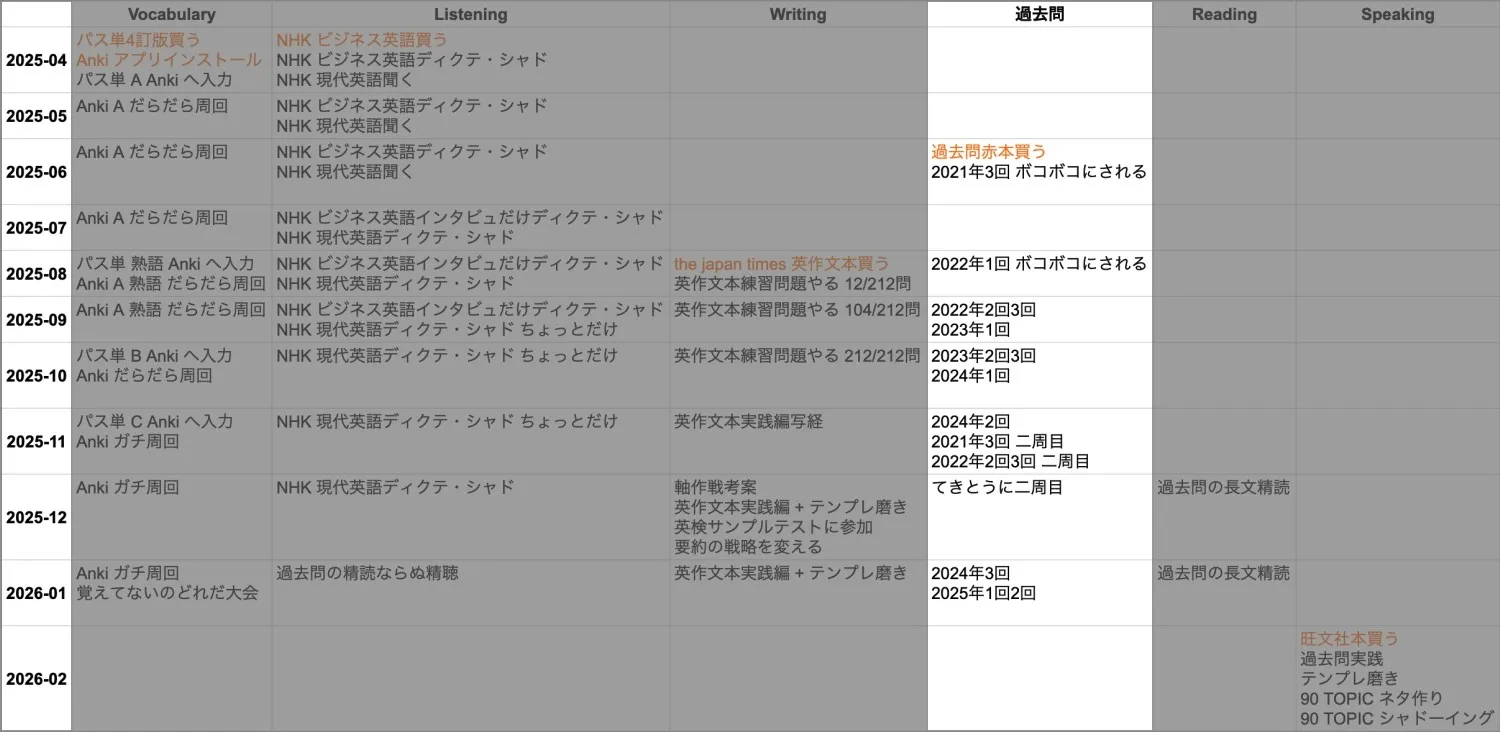
What to prepare
- Past exams from the Eiken Akahon series (https://akahon.net/eiken/index.html)
- Note: I’m happy because the Akahon series includes 9 full tests. Seriously, the more past exams you have, the better.
- Eiken Grade 1 Practice Test Drill (https://www.obunsha.co.jp/product/detail/093787)
- Note: Once you work through a lot of past exams, you realize this is still far from a complete reproduction of the real thing. The pattern of the choices feels different somehow, and the listening is way too hard.
What to do
This is another story of change over time, I guess.
- Around 2025-06, I got completely beaten up at first
- It was so difficult that even trying was hard. I took a lot of time and slowly did one full test
- My first result was 56% in Reading and 63% in Listening
- I ended up thinking, “Huh? This is actually pretty doable?” but at that point I understood nothing. Even if you get a decent score by taking three times the allowed time, splitting it over three weeks, and doing it in a quiet room, it means nothing
- By the way, for writing, this was even before the period I mentioned above as [The problem of having nothing to write], so I skipped it completely because I could think of absolutely nothing
- Around 2025-09, I started trying them little by little
- By then I had finished the A section and the idiom section of Deru Jun Pass Tan, 4th Revised Edition, so my Reading score was reaching 80%. Listening was around 65%
- Seeing that, I became just a little optimistic. Even though I was taking three times the allowed time and still skipping writing...
- Around 2025-11, I finally started to realize, “Wait... if I actually do past exams within the time limit, this is seriously impossible, isn’t it?” (Too late)
- From around this point, I started solving each section while timing myself
- Then I realized: there was absolutely not enough time! I couldn’t even reach Question 2 of Reading Part 4, and writing was still in the period of [The problem of having nothing to write], so it was hopeless
- By 2025-12, while doing a second round of past exams, I also kept doing close reading of long passages
- As for Writing, this was the period of [Do the axis strategy in my head], when things were gradually starting to look hopeful
- Since it was my second round of the past exams, my score rate itself was around 90%
- At the same time, I was doing a huge amount of close reading, which I’ll talk about later in the Reading section
- Around the same time, I remember doing the Practice Test Drill too. As practice, it was fine, but compared with real Eiken questions, it had many bad questions, which made it a bit stressful.
- In 2026-01, during the last month right before the exam, I used the latest three past exams that I had saved until the very end, timed myself, and did them on the exact same day of the week and at the exact same time as the real exam
- My score rates on those three past exams were ↓
- 2024-3: R 80%, L 78%, W I don’t know the score, but I finished in time
- 2025-1: R 89%, L 59%, W same as above
- 2025-2: R 86%, L 81%, W same as above
- My score rates on those three past exams were ↓
Thoughts
- To sum it up roughly, save about the latest three past exams until right before the test for full mock exams, and use the rest again and again as material for close reading in Reading and deep listening in Listening
- In the final stage, print out a sample mark sheet and use it. Not just to get used to the mark sheet, but also, as I mentioned in the Writing section, to get a feel for the word limit in English composition. If you study for a whole year, even your writing habits will change, so I think it’s best to use it in the final stage.
Reading
Reading is a bit of a strong area for me! I only missed one question in the long reading section. And that one was in the part I could not read because I ran out of time. So the method is probably right.
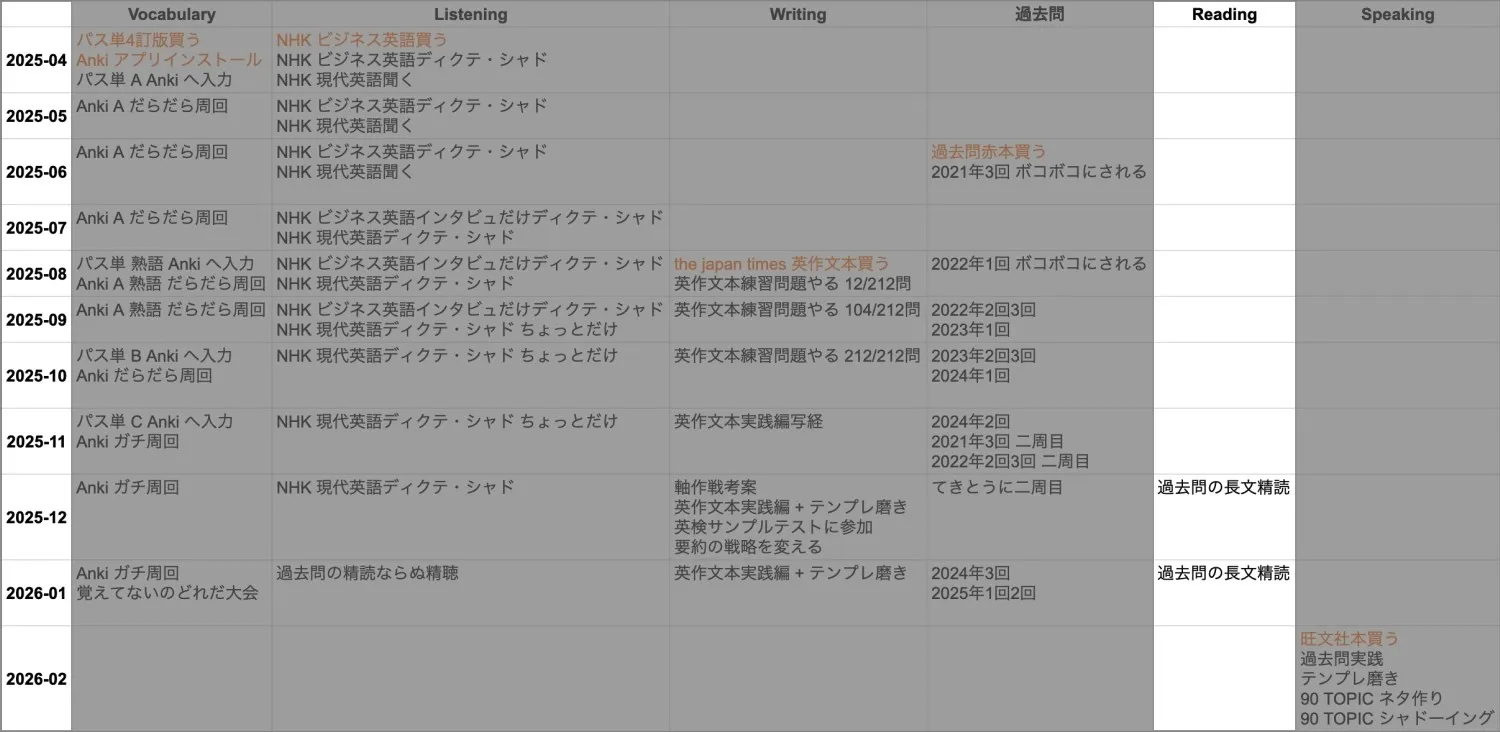
What to prepare
Past exams.
What to do
- A rough mastery of Deru Jun Pass Tan Eiken Grade 1, 4th Revised Edition is the premise
- The higher your coverage rate, the easier long reading passages become
- Around 2025-11, as I wrote above in the section on past exams, I realized, “Wait... if I actually do past exams within the time limit, this is seriously impossible, isn’t it?” The main reasons were that my English composition was too slow, and my reading speed was too slow.
- To increase my reading speed for long passages, I came up with the following study method, and around 2025-12 I kept doing this all the time
- Read the passage from the beginning and look for points where I get stuck. Getting stuck = something that gets in the way of speed reading.
- Figure out why I got stuck (I call this “finding the why”)
- Solve the cause of the problem so that next time I can keep reading without getting stuck
- Do this with the long passages from every past exam I had already done. At that time I was on my second round of past exams, so the flow was: do the second round, then do this study method on that passage.
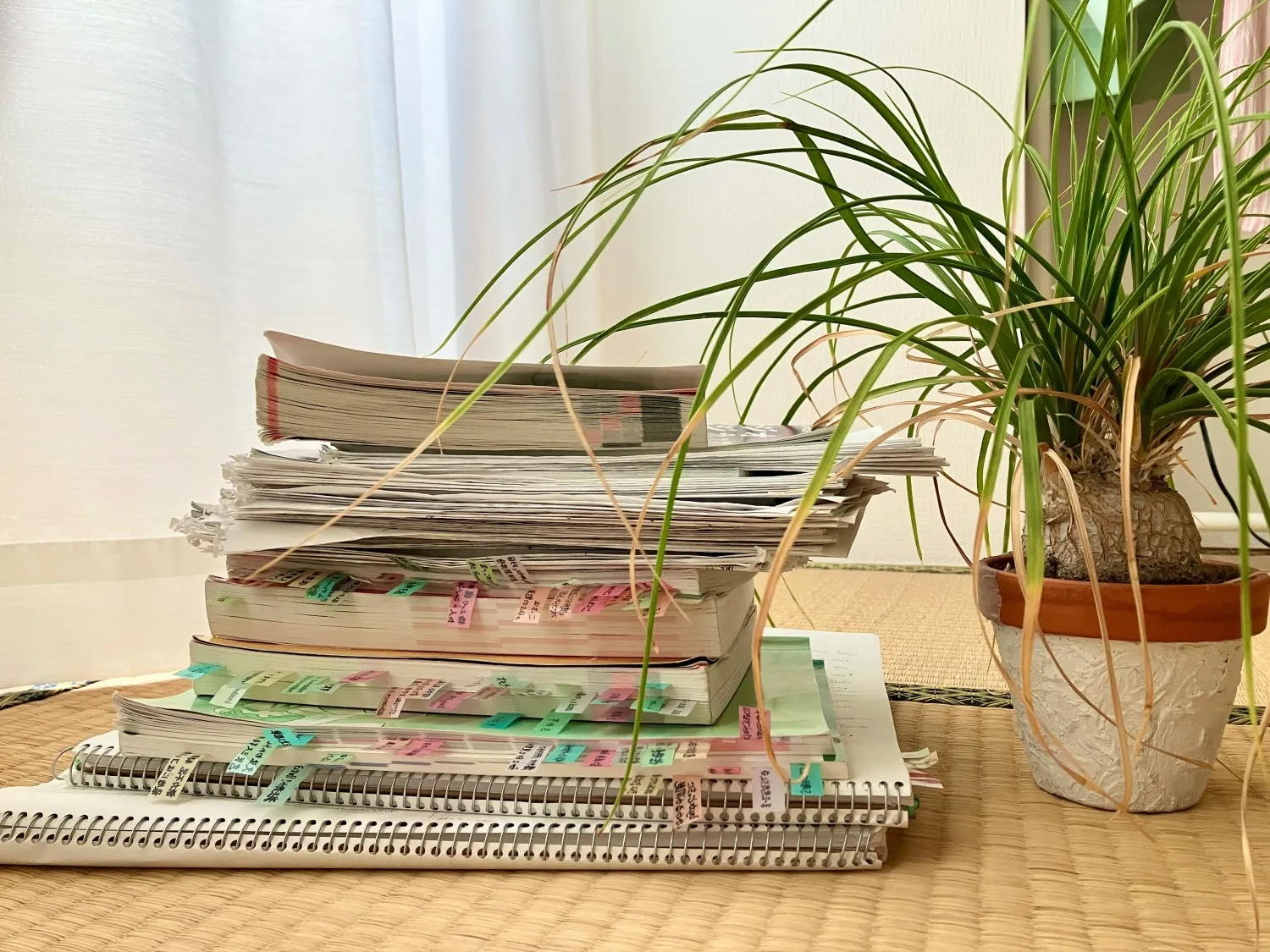
- Those are what the sticky notes in my past exam books mean. I put them on the places where I got stuck. Later, if I can read the passages with sticky notes smoothly, that means I cleared them.
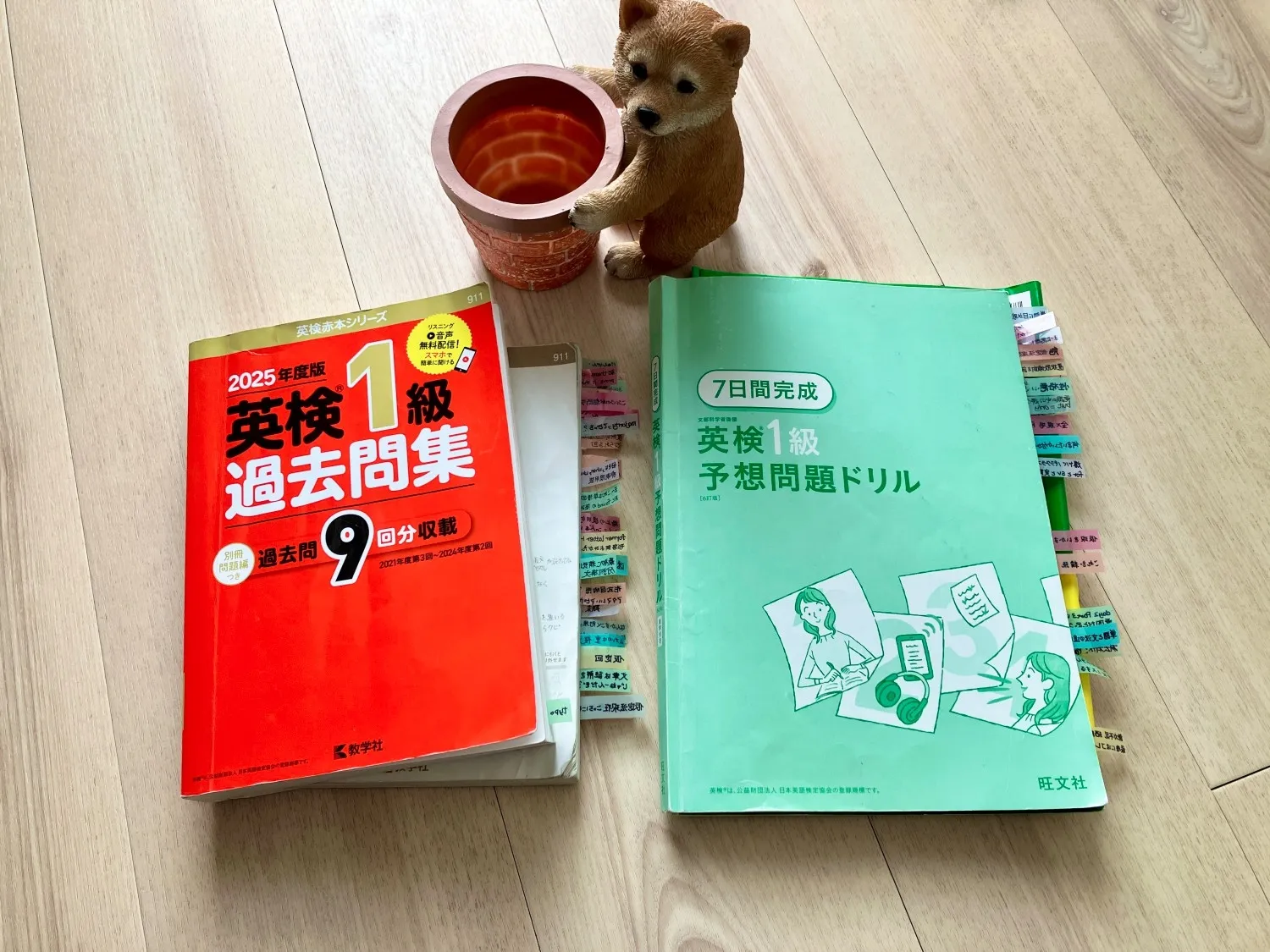
What to do during the exam
- Put a box around the main clause. In my view, the main clause is the most important. Always keep in mind, “Whose story is this sentence telling right now?”
- While reading a sentence, always keep the tip of my mechanical pencil on the subject of the clause I am reading. If I enter a that clause, I move the pencil to the main clause inside that that clause, and when I leave it, I move the pencil back to the original main clause. In my view, the subject is the most important.
Thoughts
- Once, I told an English teacher friend about this, and they said, “Oh, so you’re doing close reading.” I see, so this is what “close reading” is. So yes, I strongly support close reading. For reading, close reading is enough.
- In the real exam, I got full marks on everything I actually read, so it’s a shame that in the end I still ran out of time for one question.
- Looking back now, it was fun, but while I was doing close reading, I sometimes got angry at overly complicated sentences that forced too much processing cost onto the reader. I even left notes like, “If you wrote this kind of garbage sentence in business, you’d get fired” ↓. W-well, you know, I think it’s healthy to let off some steam with a bit of trash talk while studying.
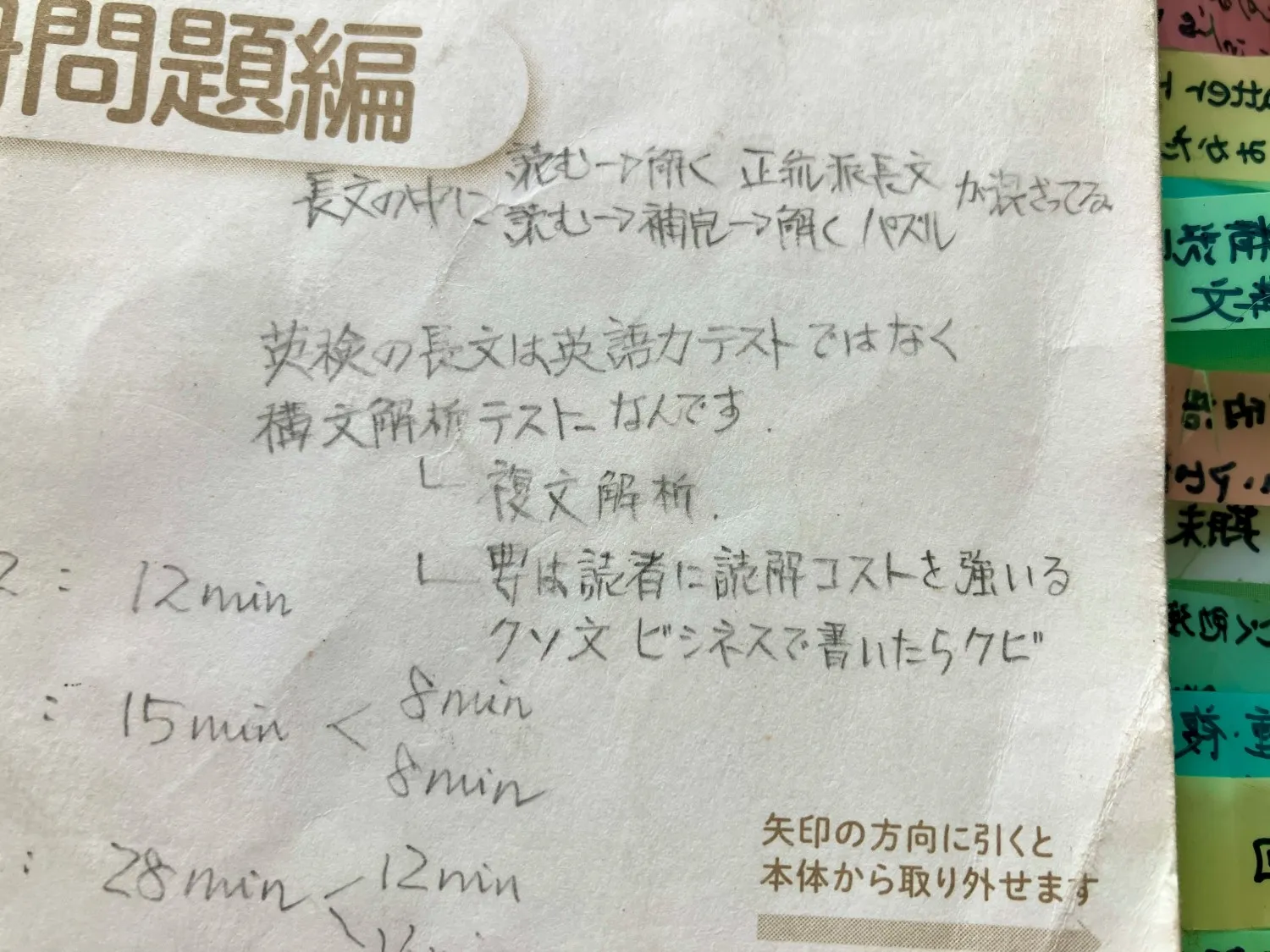
The First-Stage Exam
Maybe I’ll write about what to watch out for in the first-stage exam.
What to do before the exam starts
- Get a seat in the very front row
- This is me reflecting on the mistake I made this time, when it was my first Grade 1 experience and I ended up with the “last-row constraint”
- In a large room, if you sit near the back, the listening audio echoes and becomes harder to hear, so sit as far forward as possible
- Seriously, I have doubts about this exam environment in Eiken
- In my classroom, there were 10 or 11 people in each row. I’ve heard the first-stage pass rate for Eiken Grade 1 is around 10%, but basically I think the person who sits in the very front of each row is the one who passes (just saying)
- Bring pocket warmers
- Eiken venues are stingy, so they don’t heat the room properly
- You should keep your body and hands warm until the last moment
- This is something I learned from my Pre-1 experience
- Bring an analog wristwatch
- Also something I learned from Pre-1
- Write 05, 25, 50, 00, 08, 20, 28, 40 on your admission ticket
- These numbers show by what minute each part should be finished, starting from 14:00 when the exam begins
- This is part of the strategy
Order of solving and time allocation
- 5 minutes for previewing Listening Part 2
- In reality, I try to finish this in about 3 minutes, and write 03 next to the first 05 (meaning: I reserved 5 minutes, but finished in 3)
- Writing (Summary): 20 minutes
- After that, I keep writing the actual finishing time next to the planned time, so I can judge how much room I have left and how much I need to panic
- Naturally, writing comes first. If there are only 3 minutes left before the exam ends and at that point you are working on multiple-choice answers, there is at least a 1-in-4 chance of getting one right by luck. But in that kind of last-minute situation, there is no way you can write decent English compositions. Since I worked so hard to prepare solid templates, I should finish writing at the very beginning of the exam.
- Writing (Essay): 25 minutes
- Reading Part 1 vocabulary questions: 10 minutes
- Surprisingly, the 2025-3 exam had difficult vocabulary questions. I think I spent about 12 minutes on them.
- Reading Part 2-1 only: 8 minutes
- Reading Part 3-1 only: 12 minutes
- Reading Part 2-2: 8 minutes
- Reading Part 3-2: 12 minutes
- Somehow, I feel the difficulty order is Part 2-1 → 3-1 → 2-2 → 3-2.
- In the real exam, I still failed to finish reading one question here. I think I probably need to eliminate the initial preview time. Looking at it overall, Listening had the lowest score rate, so in the end Listening was probably dragging down the whole test.
Speaking
Speaking was really tough. My score was 30/40. Still, considering that I only had one month to prepare, I feel the overall direction of the method was right.
What to prepare
- Obunsha - Can Be Done in 14 Days! Eiken Grade 1 Secondary Test / Interview Complete Practice Questions, Revised Edition (https://www.obunsha.co.jp/product/detail/093077)
- Note: I bought this without comparing it much. I only had one month left to study anyway. In the end, I mainly used past questions, so I did not finish this book.
What to do
This is another case where I want to write about how my study changed over time.
- [A warning from my senior] Even while I was still studying for the first-stage exam, a senior who already held Grade 1 kept asking me, “Are you studying for the second-stage exam too?”
- Me: Not at all... I mean, the first stage is already so hard that I can’t even think about the second stage!
- Senior: Reaaally? But the second stage is hard too...
- [I burn out] After the first-stage exam, I was burned out. Everyone was telling me, “Good job!”, I had no motivation to study, and I had even bought a Nintendo Switch 2. But then I saw this post on social media: “Everyone who took Grade 1, start preparing for the second stage right now. At this point you still have one month, but from the score announcement to the second stage, there are only two weeks. If you start after that, there is no way you can finish preparing.”
- “There is no way you can finish preparing.” I see. So the Grade 1 second-stage exam is something that actually has to be “finished” properly. Those words hit me hard, so I asked my friends for help and started studying.
- [Real silence] I asked a friend to read the second-stage script from the Obunsha book and just tried it for now.
- Friend: Umm, okay then, “Please think about your speech for one minute.”
- Me: (thinking silently)
- Friend: Okay then, “Please give your speech in two minutes.”
- Me: (in English) Well, yes, I think I agree with that TOPIC. Umm. And then...
- Friend: ...
- Me: ...?! (real silence for two minutes)
- [Make a template] My mind went completely blank. I could not think of what to say or how to say it. I got pretty scared, as if I had suddenly developed dementia. So for now, I decided to make a template, just like I had done in writing study.
I believe that [TOPIC goes here].

First, [brief overview of the first reason].
Say about two sentences about the first reason.

On the other hand, some would argue that [counterargument goes here].
However, [its denial goes here].

In conclusion,
although there would be some opposing opinions,
I believe that [repeat the original claim].
- [Refine the template] I tried it a few times, but this template was too difficult. This kind of thing worked in essay writing, but in conversation it was impossible. Instead of moving from abstract to concrete, I decided to move from concrete to abstract.
...The beginning stays the same.

First, for example, [example for the first reason].
About two sentences.

Second, for instance, [example for the second reason].
About two sentences.

...The conclusion stays the same.
- [Could templates actually be making things worse?] I kept practicing like this with my friend, but my mind still went blank often, and I got discouraged.
- Me, flustered and embarrassed in front of my friend: N-no, I mean, if it were normal English conversation, I could speak better than this, really, really! So, um, could I try talking about it not as a speech, but more like everyday conversation?
- Friend: Sure, sure, go ahead.
- And when the conversation went that way, and I talked about the TOPIC in a casual conversation style, surprisingly, I could speak for two minutes almost normally.
- Friend: You’re talking way more than before.
- Me: Maybe doing a “speech” is impossible for me right now, and “talking to the interviewer in a casual conversation style” is my current limit
- [Throw away the template] During the “one minute of preparation,” I stopped trying to think in English about what I would say, and switched to thinking in Japanese. I aimed for this order: first have something I want to say (in Japanese, in my head), and then use English to express it.
- [I have no material] I felt a little relieved, but then I saw the real horror of the second-stage exam. Unlike essay writing, in the second-stage exam, people challenge what you say. That’s the follow-up question part. If they ask something like, “Earlier you said this in your speech, but couldn’t someone argue this instead?” and I answer, “Uh, now that you mention it, yeah, maybe, hehe...”, that means lost points. I have to be able to react to counterarguments against what I say.
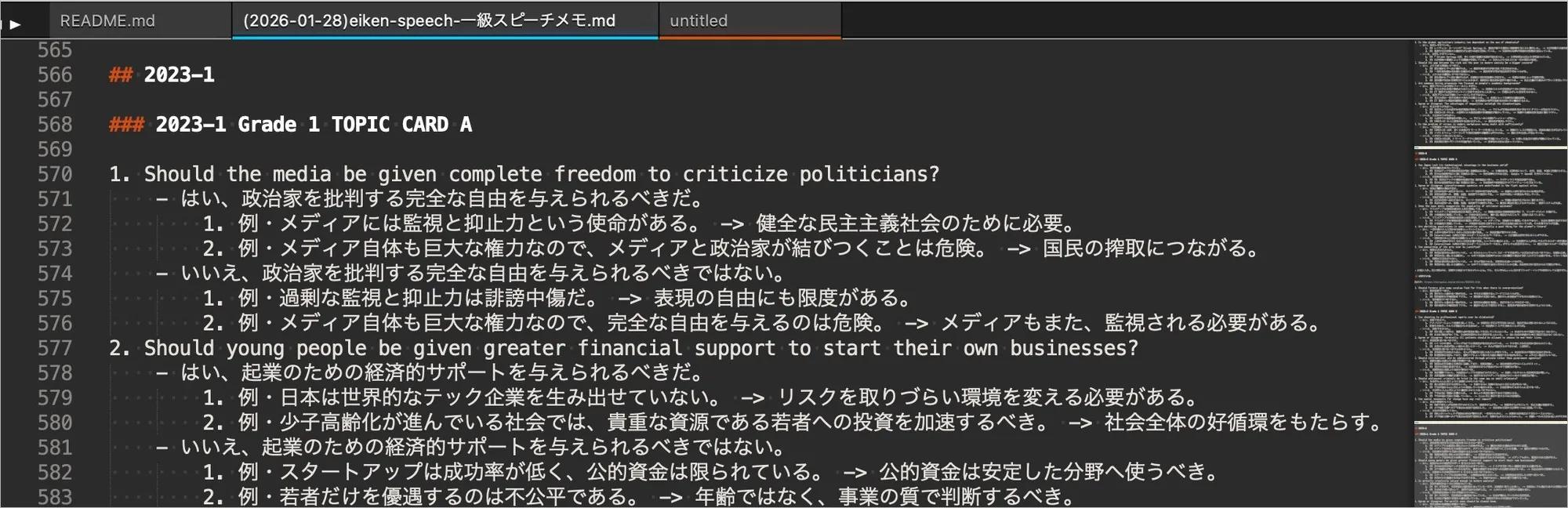
- [I’m not that smart, so I don’t really know, but if I prepare both a supporting view and an opposing view for every single past TOPIC, wouldn’t that let me survive most discussions?] With that idea, I created supporting and opposing opinions for all 90 TOPICs in the Eiken Akahon past exam book: 9 test sets × 10 TOPICs each. Like this ↓
- [Translate them all into English] I asked ChatGPT to translate them with a prompt like this.
## Your role - English translation round

Hey.
Please help me prepare for the Eiken Grade 1 second-stage exam.

### Policy

- I want you to translate the list into a form that I can speak as it is.
    - What I want to do here is this: if I do heavy full-speech shadowing every day, it gets too much, so I want to make short audio in about the following format, and keep shadowing that repeatedly. I want to make scripts for that.
    - The English level should be about CEFR B1. (This is preparation for Eiken Grade 1, but if I were actually speaking, that is probably my limit.)
    - I want the rhythm to be the same every time, so please use this format!

    ```
    ## [TOPIC goes here]
    First, (concrete example)
    ... (about one short sentence)
    ... (a sentence that gives the feeling of “wrapping up the point,” such as This suggests)
    Second, (concrete example)
    ... (about one short sentence)
    ... (a sentence that gives the feeling of “wrapping up the point,” such as This suggests)
    ```

Are you ready? If you understand, I’ll give you my notes.
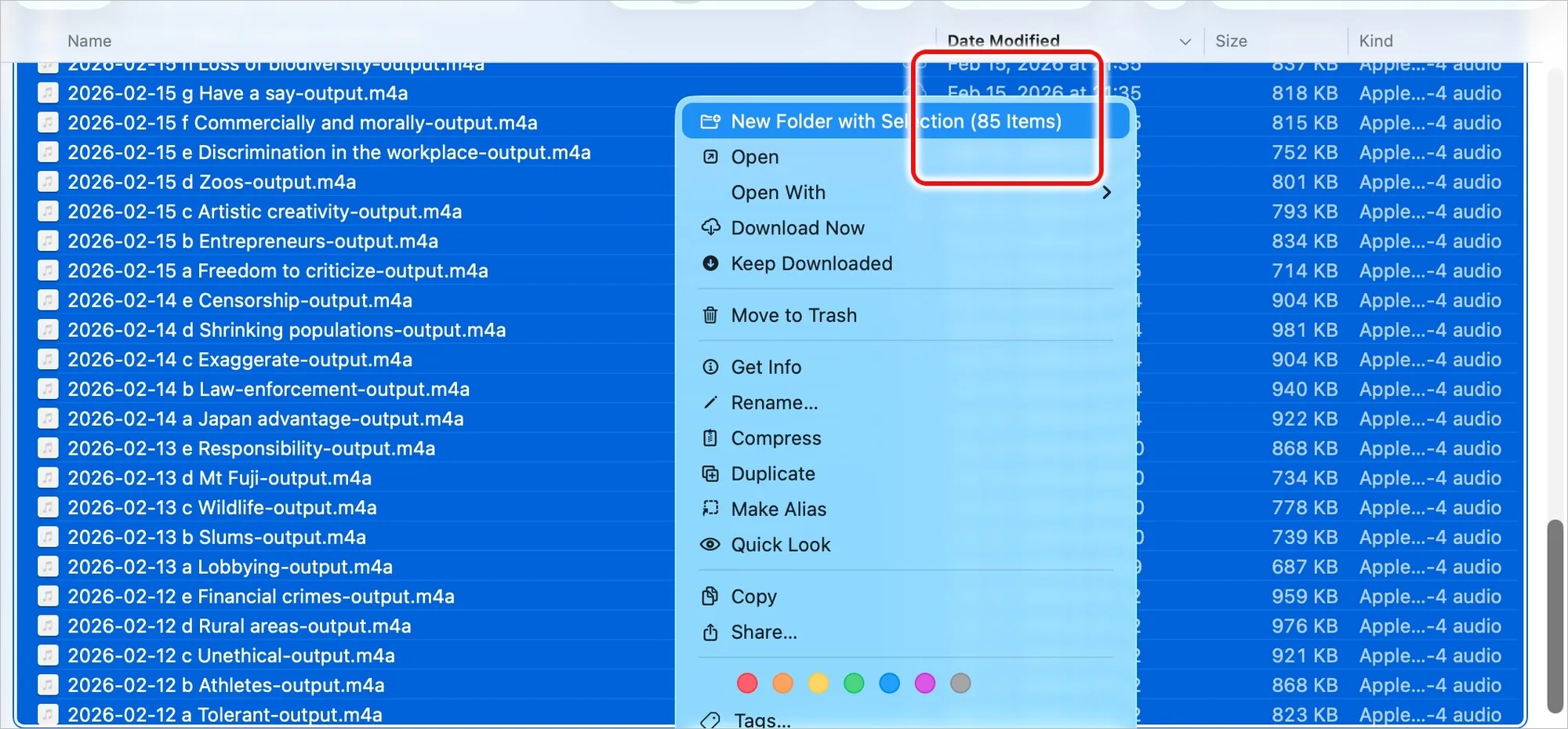
- [Record them all] Then I recorded all of them like this ↓ (Well, to be exact, not 90 but 85. I left the last ones for final practice right before the exam.)
- [Keep shadowing them] I kept shadowing all of those ↑. At that time, I used the iOS app version of VLC player. What mattered was that it could play in random order. And so, a first-stage passer was born who could somehow give shallow opinions on about 90 social issues.
Thoughts
- It was seriously a storm-like month. Up until around [Throw away the template] above was the first two weeks, and during that period I could barely speak at all. I had almost given up on passing on my first try.
- It was also a month that felt like a symbol of my whole self-study approach to Eiken. Think about a study method that fits me, throw it away if it fails, think again, throw that away too, and once I find something good, build an environment where I can keep doing it, and then continue steadily. For the first-stage exam, I had done that slowly over ten months, but in the one month of second-stage preparation, that cycle became incredibly short. So in that sense too, it was a symbolic month.
- And I must not forget that my friends spent a lot of time helping me with speaking practice. Friends from my usual group who do not know English, fellow Grade 1 challengers, and a senior who already had Grade 1 all practiced with me. No matter how much I call it self-study, speaking practice really did not work well unless I had actual humans to practice with. So I’m seriously grateful.
The Second-Stage Exam
What to do before the exam starts
- One hour before the exam, talk with friends on Discord as much as possible
- This time, my strategy was, “Rather than thinking of it as giving a speech, I’ll go there with the feeling of going to chat with the interviewers.” So right before the exam, I talked a lot with friends and got my mouth into “chatting mode.”
- It was around 8 in the morning. How little hesitation does this guy have about relying on other people? (I thanked them a lot afterward.)
Looking back on the exam
- The interviewers were friendlier than I expected. They were not stiff.
- Even in the follow-up question part, it did not just end with them asking and me answering. There were quite a few moments that felt like an actual conversation. Instead of saying the line I often used in practice, “Sorry, could you say that again?”, asking something like “Um, you said A and B and... what was the other one?” was totally fine.
- So I think my strategy of going there with the feeling of going to chat worked properly.
- I was so nervous that I got strangely hyper and ended up speaking in a lot of overly excited, off-balance ways. I could not use any of the expressions I had prepared for the exam either... (I wanted to use things like it demonstrates.)
- Still, it was good that nervousness did not push me in the direction of going silent.
The End
- Looking at it like this, I really did use ChatGPT a whole lot
- In other words, without generative AI, not a single part of my method would have worked
- Reaching this level in one year of self-study would have been impossible
- So yeah, I seriously respect the seniors who passed Grade 1 ten years ago. How did they even do it? I can kind of imagine what they used instead of the Anki app... but how did they study English composition? And close reading too would probably take more than twice as long without generative AI. That’s amazing.